
Ice on your steps or pathways is hazardous. In most cases, using icing salt can significantly reduce ice formation.
Ice and salt have been sworn enemies for eternity. Before I got married and moved to Texas, I watched my father and brothers salt the driveways. As a child, I loved to trot along the pathways and help them as much as I could. The winters were harsh in Wisconsin, and it was rather easy for someone to hurt themselves on all the snow and ice.
Fortunately, after moving to Texas, I did not have to deal with this issue anymore. However, many people have asked me how my family would use icing salt back home for this problem. Moreover, I was surprised to find that the same salt is priced differently in different states.
Hi, I’m Stacy! And today, I have carefully created this informative guide on how much you could expect to pay for icing salt. I will also tell you how to use it, so you get the best results.
Without further ado, let’s dive right in!
How Does Deicing Salt Work?
Salt efficiently lowers the freezing point of water, making it harder to create ice. By sprinkling salt on ice, you can efficiently turn ice back into water, or stop water from turning into ice. The main reason why people use salt as a deicer is because of how economical it is. Moreover, it is readily available and is easier than many other methods of melting ice.
What Are The Types Of Deicing Salts Available?
While there are quite a few salt options you can use, many are dangerous for the environment. It is essential to be aware of the harmful salts so that you can avoid using them. Instead, opt for the friendlier options for your driveway or garage.
1. Conventional Deicing Road Salt

This is the most common kind of salt used for deicing. It is widely available, affordable, and easy to use. The chemical composition of this salt is sodium and chloride.
You will find three options of conventional road salts, which differ in the way they are extracted.
a. Vacuum Rock Salt - This is fine road salt and is harmful to the environment. It is best to avoid this salt for deicing.
b. Sea Salt - This is an eco-friendly option and does not harm the environment. The grains last longer, as they are larger and coarser as compared to fine salt.
c. Rock Salt - This kind of salt is similar to sea salt and a better alternative to vacuum rock salt.
Price: You can typically buy sodium chloride for $6 for a 50-lb bag. It is the most cost-effective option and widely available in most places.
Of course, depending upon which state you are in, the prices might slightly vary, but overall, it will not be too much of a difference. In Texas, the most popular type is Rock Salt, which sells for $40 per ton.
2. Pure Deicing Salt
The best kind of deicing salt is one made in the right proportion of fine and coarse salt. Pure deicing salt is made by different brands, giving you the perfect solution for deicing your driveways and pathways.
Price: Depending upon which company you choose, you could get this salt for $1 per gallon, more or less.
3. Salt Brine
Research reveals that a composition of 23% sodium chloride is optimal for thawing ice. Salt brine contains this concentration of NaCl and can withstand temperatures of -21 °C without freezing! Moreover, it works great for preventive measures. If mixed with dry salt, it can even be used for curative purposes.
Price: Priced at 21 cents for a gallon, salt brine is a popular deicing option. However, the price may vary depending on your location.
4. Calcium Chloride
A mixture of deicing salt and calcium chloride gives birth to SALCO-18. This works well in super frosty weather conditions. However, you can simply use calcium chloride as a deicing agent, which works great. Keep in mind that this compound absorbs water quickly, so it must be stored with care.
Price: At $20 for a 50-lb. bag, this is a more eco-friendly option than the others.
Are you still wondering, “How much does salt cost?” Then I have a simple explanation for you. Depending upon the kind of salt you decide to buy and the brand you choose, the price differs slightly. You can check up the standard prices online and then decide on the most competitively priced option for your needs.
How To Use Deicing Salt?
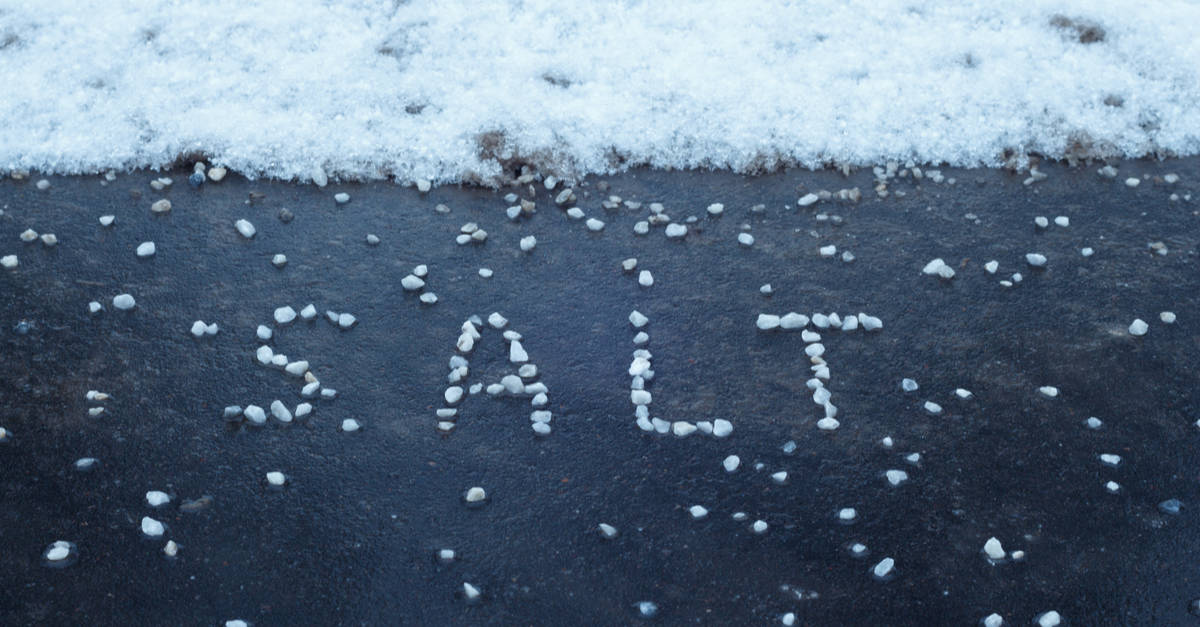
You can use deicing salt before, during, or after it starts to snow. This ultimately depends upon your needs and how much snowfall your city experiences.
1. Preventive
For this method, you spread salt before the weather deteriorates. This ensures that the amount of snow that adheres to your pavement or driveway is reduced, thus reducing accidents. You should typically use 7-20 g/m² for the best results.
2. Curative
In this method, you spread the deicing salt once it starts snowing. Your objective is to ensure that the ice can be cleared as soon as possible, opening up the roads again. Use 20-50 g/m² for the best results.
3. After Snow Removal
Here, you spread salt over the snow and ice, making it easier to remove it. However, it is recommended to opt for preventive measures rather than curative or after-snow.
In Conclusion
Using salt for thawing ice or preventing ice from forming is an effective method that has been used for decades. That being said, I also want to mention that overusing salt can cause corrosion of your concrete paths, steel in cars, trucks, and bridges.
Moreover, the salt runoff into water bodies is harmful to marine life. It is also a high possibility that wild animals may get attracted to the salt on the roads. They might walk on these busy roads trying to taste it, thereby increasing accidents.
If your state experiences moderate snowfall, then the options mentioned in this guide will work for you. However, in case of heavier snowfall, you may need to use other options.
On that note, I’ll take your leave!