
As much as I enjoy the ranch life, there is always the small anxiety of having an unwanted guest straggle into the lawn.
What could be worse than having your hard work go to waste just because of a stray animal, right? Not just for the sake of my garden but for me and my precious puppy’s safety.
Now, I am clueless when it comes to handling any animal that may stray into my land, and being alone for most of the day makes it a scarier ordeal. That’s why my husband suggested installing an electric fence charger to deter these animals away from the fencing. At first, I was hesitant for safety reasons, but I warmed up to the idea after putting an hour or two into research.
Hi! I’m Stacy, and today, I’m here with a few of the best electric fence charger options that may help you if you’re facing a similar problem.
Top 5 Electric Fence Charger Reviews
1. Patriot PE2

To start off, I chose the PE2 from Patriot - a great option for beginners. This is a lighter energizer that helps deal with those smaller unwanted creatures, preventing them from straying into your property.
Product Highlights
What makes the Patriot PE2 special is its light voltage. The entire electrical output is 110 volts, so it is actually more ideal for small animals. Now, I have many pests, including squirrels that dig through my vegetable patch regularly. And using this along the fencing did a good job of keeping them away.
This is a great choice for being pet-safe as well. As the mother of several dogs, the voltage is not enough to seriously harm them if they get too close, accidentally touching the fencing.
Not only does the PE2 work well in attaching to the fencing, but it is also light enough to be attached to other items such as posts. I could imagine using it to keep small animals from climbing onto shed roofs or overhangs. Moreover, the easy install is so convenient that I don’t give it a second thought if I need to move it somewhere else.
What's There To Like About It?
In no way am I tech-savvy enough to figure out how to begin using a device like this. But when it arrived, I realized that there was no need to worry about a simple installation; it was ready to go.
The area it is able to power says eight acres or two miles, which is more than enough for my simple garden area. And being lighter in terms of voltage, it keeps small animals out or makes sure pets don’t stray into places they shouldn’t.
What's There Not To Like About It?
Maybe for those who are looking for a more substantial voltage in their electric fence charger, the PE2 may not be the right choice. A higher voltage does keep larger animals from intruding, but it can also hurt your pets.
Additionally, while it is easy to install, the instructions say it must be weather-protected which can be a nuisance.
Pros and Cons of Patriot PE2
Pros
Cons

- No load voltage = 5,000
- 500 ohm load voltage = 2,800
- 1 year full replacement warranty
2. Zareba ESP5M-Z

I am always one for eco-friendly products, so when I saw the Zareba ESP5M-Z, I knew it was suitable for me. It has a solar panel to power it, so I found even more reasons to check out this model when I looked more into it.
Product Highlights
Of course, besides the great advantage that a solar panel brings, with convenience and energy saving, there is the fact that it lasts up to two weeks without the sun! That alone impressed me. What’s more, it supports a 360-degree rotation that will follow the sun for maximum coverage.
It is rated to energize up to five miles of fencing, with many mounting bracket options. There is also a built-in bracket to attach the charger to a T-post, Y-post, and even round wooden posts.
As for the actual power that this charger puts out, it has 0.15 joules to its name. With this much power, it is rated to deal with larger animals. To give you a frame of reference, this charger is ideal for cattle, horses, and goats, as well as other livestock.
What's There To Like About It?
I absolutely love the fact that this charger is solar-powered. If I had to say, it would be the standout feature for this model. What’s more, it is weather-proof, so it is convenient to use with its swivel and mount.
As for the area it covers, it is more than sufficient for many stretches of fencing. The five miles of power coverage that the ESP5M-Z provides is more than enough to keep those larger unwanted animals out.
What's There Not To Like About It?
It was hard to find a drawback with all these fantastic features, but the ESP5M-Z is not without its share of shortcomings. Where it lacks is the actual power that it puts out. The rating is for large animals, so if you’re mostly troubled by squirrels and racoons, this might not be the best option.
Pros and Cons of Zareba ESP5M-Z
Pros
Cons

- 5 MILE RATING: Electric fence charger for livestock energizes up to 5 miles of fencing in ideal conditions (no weeds) and up to 2.5 miles in light weeds
- VERSATILE INSTALLATION: This solar electric fence energizer features a built-in mounting bracket for T-posts, Y-posts, and round-wood posts
- BUILT IN THE USA: Electric fence for livestock is full-load tested in the U.S. after manufacturing - 1-Year Limited Warranty including lightning damage
3. Parmak DF-SP-LI
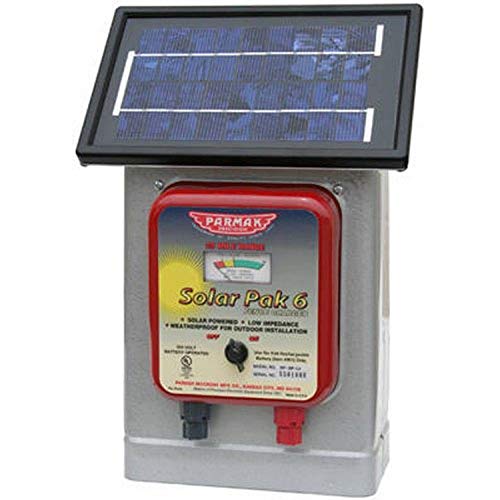
Another solar-powered electric fence charger is the DF-SP-LI from Parmak. Again, this is an eco-friendly choice; always a plus in my book. I consider this as the big brother of the ESP5M-Z with its extensive area coverage.
Product Highlights
A built-in solar panel powers this electric fence charger, covering a total of 25 miles. There is also a performance meter built-in that comes in handy when testing if the charger is working correctly and being grounded or not.
When it comes to the power output, it does not disappoint. It is powered by six volts of power, which is sufficient for keeping larger animals at bay. The intense power is also enough to shock through wet weeds and plants, perfect for a livestock pen.
Even if there is little to no sun, it was able to hold its powerful charge and supplied a sufficient enough shock. I was able to rest easy on multiple cloudy days, knowing that the charger was still packing a punch and keeping unwanted animals away.
What's There To Like About It?
To me, the best part of this electric fence charger was the power it put out. I installed this along the outer fencing to keep stray deer from wandering into my land. And I didn’t worry about coverage with such a broad range of the charger; 25 miles is more than enough coverage.
No matter what size animal could potentially roam close to the perimeter, this unit was sure to deter them well with sufficient shock.
What's There Not To Like About It?
My husband struggled a bit with the solar panel orientation. It is fixed at an awkward angle, so positioning it to absorb the sun’s rays throughout the day took some unnecessary effort.
Moreover, when I looked over the charger, the mounting panel didn’t inspire the most confidence. It is a thin metal panel, which is surprising enough that it can support such a heavy charger.
Pros and Cons of Parmak DF-SP-LI
Pros
Cons
- Will operate for 21 days in total darkness
- Weatherproof, outdoor model.
- Ideal for small to medium pastures
4. Briidea YS-201
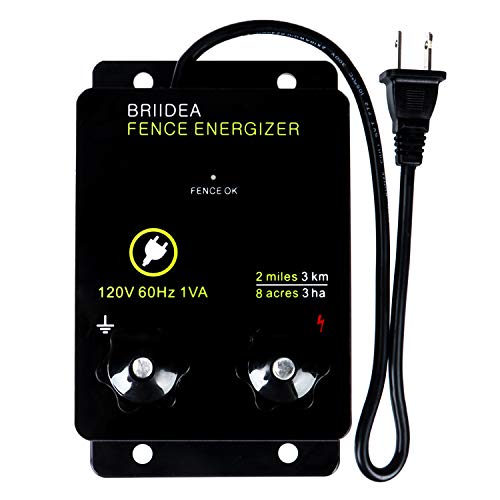
Having solar-powered electric fence chargers may not be what you are looking for. For a corded option, the YS-201 is an excellent option. Using a wired charger can help control when the fence is live or not, making it more manageable at a set location.
Product Highlights
Although the YS-201 is a corded electric fence charger, the wiring itself is durable to be installed amid nature without being damaged. The cord is durable; able to withstand rain and weather, while being capable of fire prevention.
With coverage of eight acres, this fence charger can handle any length or area up to two miles of fencing. To install the charger, plug the ground terminal into the grounding system and the red output terminal into the fence.
And to power it, connect it to a 120V power supply and switch it on. The pulse indicator light will flash every time the unit pulses. Now, the alternating pulse doesn’t make it dangerous if you accidentally touch it, but it still produces a strong shock to give even adults a jump start.
What's There To Like About It?
If you ask me, the best way to use this electric fence charger is on fences that you need to turn on and off more often than others. I would use this to prevent the puppies from straying into areas that they shouldn’t be in.
Overall, the setup is simple enough. With a ground and a hot wire to the fence, the charger is excellent at keeping the puppies and smaller animals on their respective sides.
What's There Not To Like About It?
Make sure the main box is covered and weatherproof to ensure the charger continues working efficiently. Getting it wet is definitely not a good idea, although the wire is weatherproof.
Another area I feel the YS-201 could be better is the overall build quality. Even though it is meant to be weatherproofed, it doesn’t account for other factors like dropping.
Pros and Cons of Briidea YS-201
Pros
Cons
- [Available Controlling Range] Having been designed for use with electric animal fences, the fence energizer is capable to control an area of 8 acres, and is compatible with most soil types
- [Two Terminals] This fence energizer is standard equipped with two terminals, of which one is fence ground terminal for connecting to a separate ground system, the other one is fence output terminal for connecting to the fence
- [Security Protection] With its cable having been listed by UL after a series of strict tests, this unit is more secure and reliable to use and is capable of fire prevention
5. Gallagher G341404
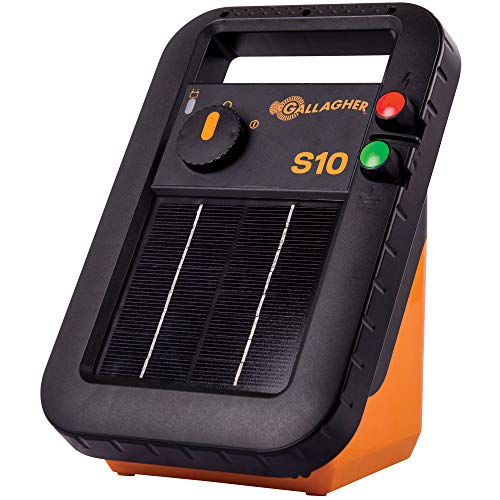
Before wrapping off the list, allow me to introduce you to the G341404 from Gallagher. It is another solar-powered option with features that set it apart from the other ones I’ve looked at. Also known as the S10, it is portable and powerful.
Product Highlights
What I like the most about the S10 is its portable and durable build. It has bumpers along the edges to protect from bumps and falls. You can leave it outside for up to three weeks even on cloudy days without any problems.
Designed to power up to a three-mile single wire fence, it may not be the most powerful charger, but it makes up for that with the peace of mind it brings. With a water-resistant casing and built-in lightning protection, it indeed does pay for itself in the quality department.
The unit also has a 360-degree mounting feature to make installation easier. Be it in a garden or for your livestock; it can be attached to any fencing you have with ease. Furthermore, it can cover around 5 to 15 acres of land.
What's There To Like About It?
I am absolutely in love with the durability and portability that this product offers. After putting it up around my smaller backyard fencing, the dogs learned not to approach the fence after a couple of shocks.
Suffice to say, despite the small package that it comes in; the charger does pack a punch thanks to the six-volt battery. Being able to function even after three weeks of no sun is an insurance that allows me to rely on the S10.
What's There Not To Like About It?
The power output doesn’t give enough charge to shock through the foliage, so make sure your fence is well-tended to ensure it works properly.
Additionally, the shock it gives off may not be enough to deter larger animals like big dogs or sheep. Some stronger animals can bear the shock and power through, so a more powerful electric charger may be needed for such instances.
Pros and Cons of Gallagher G341404
Pros
Cons

- Tough outer casing and built in lighting DIVERTER
- Ideal for garden protection, temporary grazing applications, livestock, and pet containment
- 360 Degree mounting for correct placement toward the sun
Buyers Guide
If you are like me and have no idea what to look for while choosing the best electric fence charger, then worry not. Here are a few points that you should look for when going over your options.
1. Type Of Animal Being Contained
The type of animal you are trying to keep in or out of an area is one of the first points you should pay attention to. Different chargers have different power outputs and will not be as effective on some animals as their bodies can handle the electric shock.
To make sure you aren’t wasting your money on a charger, check if it is powerful enough to affect that animal or not. The thickness of an animal’s hide or hair, and the insulation that their hooves or pads can provide, can negate the weaker charges.
What’s more, if you are dealing with aggressive animals like bulls or bears, they may require a more powerful electrical charge to be deterred. Keeping in mind what animal you are dealing with should always be kept in mind.
2. Fencing
The material that your fencing is made of will change how well the electrical charge passes through it. For example, fencing made of steel wiring is a great conductor and does a better job in carrying the charge over rope or tape.
If you are working with a fence material that has high electrical resistance, using an electric fence charger with a low impedance will be helpful. Basically, this means the charger will send the charge through foreign materials like grass or the high-resistant fence material easily.
These chargers are also a good idea for areas with a lot of weeds and grass touching your fencing.
Every electric fence charger will have a mileage rating to tell you how much fencing it can power. This mileage is for a single row of steel wire fencing with no foliage touching it. So, keep this in mind when picking a charger - whether or not it is powerful enough to cover the area you have.
3. Number Of Fence Lines
Another point to keep in mind is how many rows of fence lines you are trying to keep charged. To keep all of them charged, divide the charger’s distance rating by the number of rows in your fence. By having the power flowing separately through all the rows simultaneously, no power will be lost, and the charge will be distributed equally.
It may seem confusing, but the basic concept is simply increasing the power when you have more than one row of charged lines in your fence. This increase in voltage is done to accommodate for lines pulling power away from other lines.
4. Power Source
There are three power sources that electric fence chargers have. The first is an alternating current (AC) that has a wired power source. This option is great in case you have access to a 110-volt power source nearby. As they are wired and have a constant steady supply of power, they are the more powerful chargers.
A direct current (DC) powered charger is essentially a battery-powered electrical charger. As it is battery powered, it is prone to be depleted. And as for the rate at which it is drained, it depends on how often the wire is touched. A rechargeable, high-volt battery is a recommended additional purchase if you are looking into this type of fence charger.
The third power source is a solar-powered electric fence charger. These are also “wireless,” similar to the DC power source. This charger is ideal for areas with no access to a dedicated power source with an attached solar panel. It has a battery that collects power and uses it as needed and can last around three years.
You should choose a charger with a suitable power source depending on the availability of a power source in the installation area. This is a crucial factor as the electric charger will be rendered useless without a sufficient power supply.
Frequently Asked Questions
The power being sent through your fencing via the electric charger can fluctuate depending on a number of factors. When setting up the electric fence charger, one common occurrence is not setting up a proper grounding system.
This could be in the form of not enough grounding rods; they might not be buried deep enough or simply because of the presence of a particular type of soil or metal in the ground.
Additionally, any foliage or weeds that may be in contact with the actual live fence wire will draw power away. Broken insulators in the charger itself can also lead to the charge leaking into the post and not the fencing.
A voltage rating is the amount of shock that will be felt when anything comes in contact with the live fence wire. It is the difference in charge between the grounding wire and the output wire on the fence.
The farther away you get from the electric fence charger, the weaker this voltage will become. So, to accommodate for this, as well as other factors that may be draining power, it is advised to get an electric fence charger that has a stronger voltage. This will ensure that the animal you are trying to contain receives adequate shock that is effective in deterring them.
Having a UL certification on the electric fence charger is a mark of safety. It signifies that the product meets all the U.S. safety laws for consumer electronics. You can check if a charger is UL-certified by looking for the marking on the back of the charger or somewhere on the packaging.
My Final Recommendation
After using several chargers, what would I recommend as being the best electric fence charger?
For starters, the Patriot PE2 does seem to be the safest option for beginners with its durability and easy setup. But for those who need to cover larger areas or prefer having a wired charger, the Briidea YS-201 would be an ideal choice.
And the most notable charger I found is the No products found..tcb-post-list #post-106330 [data-css="tve-u-16ecb5f152e"]{background-image: url("https://eadn-wc01-2912785.nxedge.io/cdn/wp-content/uploads/2023/09/how-hot-does-a-pressure-cooker-get-2.jpg") !important;}}
How Hot Does a Pressure Cooker Get?
How To Stop Pressure Cooker Burning on Bottom: Tips and Tricks