
Black Medic (Medicago Lupulina)
Binomially also known as Medicago lupulina, Black Medic is placed in the family Fabaceae. The members of the family include beans, peas, and legumes which are characterized for bearing legumes and compound leaves. Black medic is a surface growing summer annual weed that contains broad leaves that could grow everywhere except deserts, and up to the height of 2500 meters above sea level.
Origin and Distribution
Black medic originated from temperate Asia and Europe to become a serious occupant of agricultural settings including turfgrasses, orchards, and landscapes. It’s an excellent cover crop in range and forest lands that livestock happily forage on. Generally, it contaminates Clover and Alfalfa seeds to become a nuisance in commercial farming. Black Medic is now a serious weed issue in the lawns, orchards, landscapes, and inattentive places throughout the US.
Identification
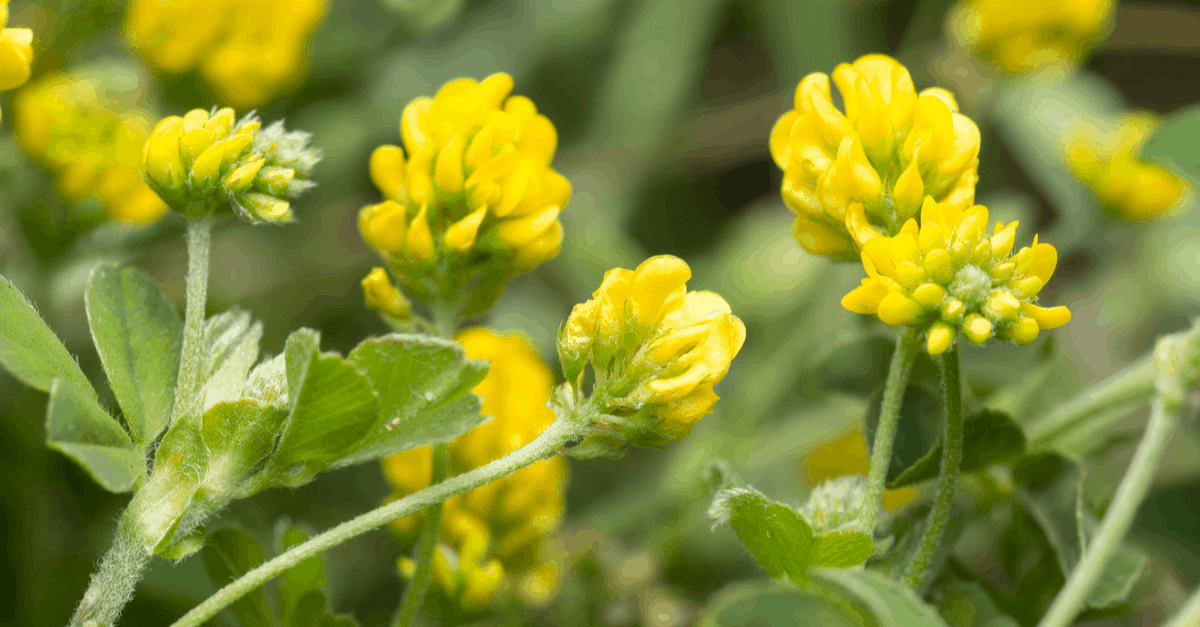
Black medic contains a taproot system that grows intensively into the soils with good moisture retention ability. Several small branches emerge from the main stem close to the ground that could extend around 24 inches on the surface. Like all other leguminous plants, Black Medic also forms root nodules to fix nitrogen for the host plant and itself. It produces tiny bright yellow flowers arranged in the clusters. Flowering continues throughout the active growing season which, stops at setting seeds. Honeybees are the most frequent flyers along with common pollinators. The fruit is kidney-shaped that turns black at maturity producing brown or gold seeds.
Black Medic Lifecycle
Usually, Black Medic is a summer annual that sometimes shows the characteristics of perennial plants but, does not stay long in cultivated soils. Germination starts in spring, and flowering could continue from mid-spring to early autumn. The seeds disburse through birds, animals, pollinators, and natural means, and they could become dormant for years depending on their depth, available moisture, and soil temperature. Upon having favorable conditions, the Black Medic could infest lawns outcompeting the turfgrasses and the garden beds. Generally, Black Medic emergence in turfgrass is a sign of poor fertility and low maintenance. Often, Black Medic and White Clover need a similar type of conditions to grow and flourish in a landscape.
Physiology & Spreading Pattern
Much heavier Black Medic infestations are a sign of the limited number of Mowing compared to what was required. Late Mowing disburses the seeds in turfgrasses that sprout on gaining favorable conditions. Moreover, the pollinating agents also transfer Black Medic seeds from one to another field. Usually, a dense and vigorous turfgrass would not allow Black Medic to grow to the heavier infestations. If it happens, there might be two possibilities: either your turfgrass is not suitable to the climate where it grows or it was not maintained to the extent it was needed. Proper fertilization could address the deficiencies along with choosing a turfgrass variety that is adaptable to your climate conditions. Other than low soil fertility, sometimes its compaction also helps in promoting its growth and that's a reason you often notice Black Medic growing at neglected places. Black Medic is a tough weed that utilizes poor resources for growth. So the focus is required to maintain turfgrasses and garden beds in good health.
Fun Facts About Black Medic
Black Medic Control and Prevention
Cultural Control
The best practice is to pull the weed with hands. Since its regrowth primarily depends on the number of viable seeds present in a landscape before it germinates. Pulling a weed with hands before it starts flowering could reduce infestations to a considerable level in the next spring. Especially, hand pulling the weeds when soil is soft and wet makes it easy to remove. If the hand-pulled weed clippings don't contain seed, you can utilize them as a mulch or decompose them to make compost for garden use. Other cultural controls involve selecting adaptable turfgrass varieties and improving their health, vigor, and density in a lawn.
Organic Control
FeHEDTA
The University of Maryland, Extension Department suggests applying HEDTA chelated Iron which contains 4.43% actual Iron that induces oxidation in Black Medic plants that induce necrosis. This necrosis dries up the weeds, turning them black, and killing them after a few hours of application. However, Fe-based products need spraying Black Medic and other broadleaved weeds below 80 °F, Otherwise, stress is observed on turfgrass which takes 3-4 more days to recover.
Chemical Control
Pre-Emergence Herbicides
Pre-emergence herbicides can be applied on the naked surface while preparing a garden bed before planting. Generally, these products are non-selective herbicides that stop the growth of all sorts of weeds. There must be a 7-days delay in planting turfgrasses in lawns or garden beds after applying non-selective herbicide such as RoundUp that contains 50.2% Glyphosate.
No products found.
Post-Emergence Herbicides
These herbicides are safer for the turfgrasses and the lawns as they selectively kill only broadleaf, narrow leaf, or the target weeds.
Blindside Herbicide WDG
Blindside is a selective herbicide that can be used freely on turfgrasses and lawns to control Black Medic without giving them any stress. It combines 60% Sulfentrazone & 6% Metsulfuran Methyle which get absorbed by the roots of the targeted plants and kill them in 3-4 days. Mix 0.20-0.25 ounces in one gallon of water and spray on Black Medic-infested areas. Do water your plants immediately after applying Blindside to see speedy results.
No products found.
Bonide (BND066) - Weed Beater Plus
Bonide mixes three different selective herbicides to kill a variety of broadleaf weeds including Black Medic. Never try this combination on St. Augustine and Centipede turfgrasses. The gardeners can connect this container with a garden hose that mixes with the water automatically and may be sufficient for 600 square meters' turf area. This mixture includes 2,4-D, Dicamba, and Quinclorac that target more than 200 lawn weeds.
No products found.
Quinclorac 75 DF
75 DF means it contains 70% of the active ingredient which is Quinclorac in the state of dust flowable. The gardeners may mix 1 tablespoon of Quinclorac in 1-gallon of water to spray on Black Medic using a Knapsack sprayer. The yellowing of targeted weeds may occur in 48 hours, and complete coverage is expected within 7 days of application.
No products found.
Learn How to control and get rid of other weeds in our complete Yard Weeding Guide.