
Binomial Name: (Cyperus rotundus)
Nutsedge is a perennial broadleaf weed in the family “Cyperaceae” and the Genus “Cyperus". It is a family of monocots that look like grasses and flowers in the summer. Nutsedge is a common weed in landscapes and gardens in waterlogged soils and is often found in the places like ponds, ditches, and water reservoirs. Its presence is an indication that the land is poorly drained, or the irrigation schedule is frequent. It grows more frequently in marshy areas and grows up to an elevation of 8200 feet. It causes a tremendous loss to crops and landscapes and is considered the World's worst weed.
Origin and Distribution
Nutsedge is considered a native from multiple origins and varying climates since it grows vigorously, whenever it finds waterlogged soils. Southern Asia, Africa, and Europe, especially Austria and France were considered its stronghold that later spread to Southern parts of California. It grows abundantly in coastal valleys and Central Valley in California up to an elevation of 3300 feet. Overall, Nutsedge is a common weed throughout the temperature and tropical areas of the US except for Montana and Wyoming. Since, Nutsedge grows in uninterrupted, waterlogged, and disturbed soils, it is now a common pest along the margin of rivers, streams, ravines, and marshes in the country.
Identifying- Nutsedge (Cyperus rotundus)

A Nutsedge plant may gain a height of up to 55 inches. The underground tubers resemble nuts, and for that reason, it is also called "nutsedge". Its leaves emerge from the base in a cluster of three that measure 6 to 8 inches long. The flowering stems contain a triangular shape, and the flowers are bisexual bearing both female and male parts, three in number. The inflorescences may have 3 to 8 uneven spikes. The fruit is tri-sided achene. Immature plants initially form a fleshy rhizome, white in color, chained, and diameter around 1.0 inches. The flowering stem is purple that bears seedpods that resemble an antenna.
Nutsedge-Propagation and Lifecycle
Nutsedge often doesn't produce seed, and their spread occurs primarily through underground tubers and rhizomes. The tubers, even submerged to a depth of 2.5 feet, can produce new growth giving rise to a new plant. Nutsedge tubers can survive severe cold and chilling is required to break dormancy. However, an optimum temperature to germinate tubers remains somewhat above 43°F. Nutsedge tubers can remain viable for up to 4 years under ideal conditions.
A few Nutsedge rhizomes form a nuts-like structure that grows upward to make a new plant. New plants typically behave like adult plants, and within one year of growth, resemble adult plants. Some rhizomes grow downward and others horizontal. The result is to make chains of tubers expanding to several feet within the soil.
Fun Facts About Nutsedge
Nutsedge-Prevention and Control
Cultural Control
Nutsedges are a species of moist areas, and their tubers can survive in the soil for years. If the gardeners can identity their tubers, there are no chances that they will bring them home in nursery plants or planting material. Mowing the turfgrasses is equally good besides applying Nitrogen and Potassium fertilizer that increase their vegetative growth since this practice drags the turfgrasses out of Nutsedge competition. Otherwise, the gardeners may dig the small patches formed in the turf. Digging the soil to a depth and spreading width of 12 inches could possible prevent the infestation of Nutsedge in the coming year. The best digging time remains early spring when the tubers start spreading underground.
Chemical Control
Control using Pre-Emergent Herbicide
Roundup Plus
Roundup Plus is the only post-emergent herbicide with a non-selective action. It kills everything green that comes under its spray mist. The gardeners may use it when Nutsedge grows actively around garden beds, patios, and landscapes. However, even Roundup Plus needs repeated applications especially, when Nutsedge plants possess 4 to 5 true leaves.

The gardeners may add 6 ounces of Roundup Plus in one gallon of water to target Nutsedge and other grasses.
Control using Post-Emergent Herbicides
Ortho Nutsedge Killer
Ortho Nutsedge Killer contains the active ingredient Sulfentrazone 1.40% (Weight/volume) in its 32 ounces’ pack. It’s a selective herbicide that kills Nutsedges and several other annual, biennial, and perennial weeds in turfgrasses that emerge from the rhizomes or tubers. Ortho Nutsedge Killer is in a readymade formulation, and connecting a garden hose could enable the gardeners to spray it on target weeds.

- Kill nutsedge (nutgrass), kyllinga and over 50 other tough weeds with Ortho Nutsedge Killer for Lawns Ready-to-Spray
- This lawn weed killer also controls wild violet and dollarweed, and selectively controls other listed sedge and broadleaf weeds, including dandelion, purslane, and spurge
- Weed killer for lawns may be used on well-established Northern and Southern turf grasses
Ortho Nutsedge Killer can be applied to most of the Southern and Northern turfgrasses.
One 32-ounce bottle covers 5000 square feet approximately, and spray repetition may be required after 2-3 weeks of the first application.
Sedge Ender Weed Control Concentrate
This concentrate combines Prodiamine with the already discussed ingredient Sulfentrazone. The blending ratio remains 1.36% for Sulfentrazone and 2.73% for Prodiamine, making them an ideal mix for killing Nutsedge tubers and several other broadleaf weeds in your turfgrasses. This product is also safe for the majority of turfgrasses in both growing seasons. This combination kills already germinated Nutsedge and stops the tubers to grow new shoots.
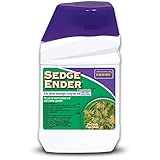
- Sedge Ender Weed Control kills unwanted weeds without killing your lawn; kills yellow nutsedge, crabgrass, goosegrass, foxtail, and other grassy weeds down to their roots
- Use on both warm and cool season grasses for complete coverage; safe for bluegrass, ryegrass, fescue, Bermuda grass and carpet grass
- This product is designed for application before or after weeds have sprouted, it kills the roots and shoots of existing weeds while preventing the growth of newly emerged weed seedlings
The concentrate is available in a pre-mixed formulation that can cover about 5000 to 8000 square feet of Nutsedge’s infested turfgrasses.
SedgeHammer+ 13.5g
SedgeHammer+ is a specialty herbicide that contains new product chemistry, Halosulfuran, which is needed in very minute quantities to control Nutsedge from the 2-4 leaf stage till its final vegetative stage. SedgeHammer+ is equally effective against all grasses that sprout from tubers. Its Active Ingredient Halosulfuran (5%) absorbs through plants' foliage and reaches deep down to underground growing points. Which are responsible for a new shoot and leaves development. SedgeHammer+ works excellently on St. Augustine, Bermuda, Kentucky bluegrass, and other cool & warm-season turfgrasses.

- ELITE WEED DEFENSE - Sedgehammer + offers unparalleled defense against nutsedge & up to 25 additional challenging weeds. Crafted for the discerning homeowner for small-scale use, this nutsedge weed killer quickly transforms your landscape into a verdant sanctuary
- PROUDLY MADE IN THE USA - Sedgehammer herbicides are all made in the USA, embodying the pinnacle of premium quality that every yard deserves
- SIMPLY MEASURE, MIX, & APPLY - Our nut grass killer for lawns redefines user convenience with its integrated dry, non-ionic surfactant, creating a weed killer mix without the extra additives. With crystal-clear instructions, it provides an easy, hassle-free experience
One 13.5-gram pack is for mixing in one gallon of water to spray on targeted weeds including, Nutsedges.
Learn How to control and get rid of other weeds in our complete Yard Weeding Guide.