
Binomial Name: (Rumex acetosella)
Sheep Sorrel is a broadleaf perennial herb from the family "Polygonaceae” and the Genus “Rumex”. Polygonaceae is called the Buckwheat family throughout the US. Sheep Sorrel was introduced to most of the Northern Hemisphere and usually flourishes on acidic and sandy soils in grasslands and hilly areas. Sheep Sorrel is often among the pioneer invaders of disturbed lands if the soil is acidic. It's also the home of the American Copper butterfly which, feeds on Sheep Sorrel, and its larva feeds on the new growth. Livestock also feeds on Sheep Sorrel but, excessive grazing may be a toxin due to the presence of a large amount of oxalic acid. Sheep Sorrel can manage to grow up to 8800 feet above sea level.
Origin and Distribution
Sheep Sorrel is native to Southwestern Asia and Europe But deliberately introduced in many areas of the world in agricultural and ornamental settings except for tropical Africa and equatorial regions of South America. This widespread species is reported invasive in Arizona, Connecticut, Hawaii, New York, Oregon, Tennessee, Virginia, Washington, Wisconsin, and West Virginia in meadows, agricultural fields, parks, domestic and commercial lawns, and open woodland. Sheep Sorrel also recovers quickly from the clipping and grazing shocks hence the reason for its perseverance in pastures, grasslands, and turfgrasses. Due to its clever adaptation to a variety of climatic conditions, Sheep Sorrel could establish itself at a new location rapidly.
Sheep Sorrel-Identification

Sheep Sorrel can grow up to 12 inches in height. Usually, the stem is slender upright that branches at the top and is reddish in appearance. The simple leaves represent an arrow shape that may grow up to 3 inches long having a pair of horizontal lobes near the base. Lower leaves are without lobes, and their appearances are like a spade. Flowers form a cluster at the top of the branch which, varies from green to red. Both male and female flowers exist on separate plants. Usually, male flowers are yellow and female in green. Flowers bloom from early summer to early autumn which, produces reddish or gold seeds with light brown husk. Generally, Sheep Sorrel seeds remain viable from 10 to 20 years. The root consists of shallow fibrous and horizontal roots that can travel deep into the soil up to 5 feet.
Sheep Sorrel-Propagation and Lifecycle
Sheep sorrel propagates both by seed and rhizomes. Pollination occurs through the wind. A male plant usually produces one achene per flower, each containing about 250 seeds per shoot. However, the US climate may support the production of about 1600 seeds per ramet. Optimal seed germination may be observed between 64 to 86°F. Sheep Sorrel seedling emergence occurs throughout the spring that continues up to autumn. Sheep Sorrel also propagates by vegetative means and uses its adventitious roots that arise from the rhizome. Once planted by seed through dissemination, an individual Sheep Sorrel plant can retain its vegetative propagation for the next 15 years.
Fun Facts About Sheep Sorrel
Sheep Sorrel-Prevention and Control
Cultural Control
Removing the entire Sheep Sorrel plant including, the rhizome is beneficial during early spring. Hand pulling can be done during this period when the turf has good moisture content. Otherwise, water your lawn one or more days earlier before going into hand-pulling practice. Early moving can also suppress Sheep Sorrel growth, and it must always remain a focus that Sheep Sorrel doesn't flower. Otherwise, seeds dispersed into turfgrasses can germinate at any time offering the gardeners a tough time ahead. Also, focus on fertilizing your turfgrasses to bring them out of the competition of Sheep Sorrel so that they thrive to suppress Sheep Sorrel growth.
Chemical Control
Control using Pre-Emergent Herbicide
Roundup Quickpro Dry Formula
Roundup QuickPro is a non-selective herbicide that mixes 73.3% of Glyphosate, and 2.9% of Diquat dibromide in a granular formulation. Diquat is associated with quick foliage burning whereas, Glyphosate is a slow starter that might take 8 to 14 days to have a complete hold of Sheep Sorrel and other weeds in the scene. This chemistry can be applied anywhere that supports undesired plant populations. It's one of the best products to use around garden beds for killing existing and predicted weeds. Due to its non-selective nature, it kills every type of vegetation that gets targeted.
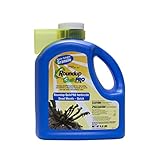
- Roundup QuickPro Herbicide is for use anywhere there is undesirable vegetation. Extra care should be taken to ensure that non-target vegetation is protected from any drift.
- Glyphosate 73.3%, Diquat 2.9%
- The mix rate for Roundup QuikPro is 1.5 ounces per gallon of water.
Add 1.5 ounces of Roundup QuikPro in one gallon of water to target all types of weeds including, Sheep Sorrel.
Control using Post-Emergent Herbicides
Chickweed Clover and Oxalis Weed Killer
Typically designed to kill many broadleaf weeds, Oxalis Weed Killer combines three different broadleaf herbicides that perform selectively. This combination contains 2,4-D, Triclopyr, and Dicamba Salts in a ratio of 0.74, 0.084, and 0.072%, respectively. This ready-to-use product works both through leaves and roots absorption. Additionally, a specially designed nozzle allows the gardeners to apply this herbicide conveniently. This product mixture kills Sheep Sorrel and several other broadleaf weeds that hinder the growth of turfgrasses in your lawns.
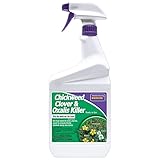
- TOTAL WEED KILLER - Spray eliminates chickweed, clover, dandelions, ground ivy, oxalis, wild violet and over 100 more tough-to-control weeds. A complete list of these weeds is displayed on the label.
- AFE FOR GRASS - Designed to kill a variety of weeds, not lawn grasses. When used as directed it kills broadleaf weeds in lawns, roots and all.
- READY TO USE - This product is conveniently ready to use when it arrives. The spray nozzle makes this product easy to deploy.
One pack herbicide bottle can easily cover 10000 square feet of turfgrasses.
Ortho Weed B Gon
Another selective class of product that contains specialty herbicide is Triclopyr (8%) which targets most broadleaf weeds including, Sheep Sorrel, Oxalis, Clover, and Chickweed in the turfgrasses. This product is also ideal for spraying on targeted weeds around the garden beds. Overall, product efficacy remains between 85 to 90% when targeting a broad range of weeds. Ortho Weed B Gon works well when the targeted weeds are actively growing. Overall, the optimum surface temperature must remain below 90 F when targeting Sheep Sorrel and other broadleaf weeds in turfgrasses. This product comes in concentrate and a ready-to-use formulation.
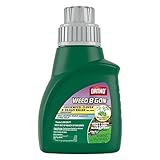
- Ortho Weed B Gon Chickweed, Clover & Oxalis Killer for Lawns Concentrate kills tough weeds including chickweed, clover, creeping Charlie (ground ivy), oxalis, wild violet and others as listed
- This weed control product kills listed weeds to the roots and won't harm lawn grasses when used as directed
- Use this lawn weed killer on grasses including Buffalograss, Fescues, Kentucky Bluegrass, Ryegrass, and Zoysiagrass
A ready-to-use product needs to connect only a garden hose with the pack. A concentrate otherwise needs mixing 1 ounce in one gallon of water to spray on 200 square feet area of turfgrasses.
Learn How to control and get rid of other weeds in our complete Yard Weeding Guide.