
Are you new to the world of vegetable gardening? Does differentiating between the seeds seem like an unsolved mystery?
It’s quite alright because, let’s be honest, it’s common to kill a few plant babies starting out. This just signifies that there is a lot of room for you to evolve as a gardener alongside your green vegetable patch.
Reflecting on those early years reminded me that it’s very important to get proper guidance when you are new to this field; otherwise, it’s quite easy to get lost. I was lucky to have a knowledgeable and kind-hearted gardening teacher to guide me through it all.
She also suggested some of the best vegetable gardening books of her time to ensure that I got all my concepts clear. So, this article is sort of my tribute to Mrs. Green, which includes some of my tried and tested books.
Let’s get into the details now!
Best Vegetable Gardening Books
1. The Vegetable Gardener's Bible

Brief Product IntroI’ll begin my list with my absolute favorite book - the one I referred to like a bible during my beginning years - The Vegetable Gardener’s Bible. It’s named so for a reason, so keep reading to find out.
Product Highlights
This masterpiece from Edward C. Smith holds some of the most effective secret hacks to growing high-quality vegetables with good yield. To get you started, it approaches gardening with the classic WORD technique, which has worked out phenomenally well for most American gardening regions.
The system goes like this:
- W - Wide rows
- O - Organic methods
- R - Raised beds
- D - Deep soil
But that’s just the beginning; there’s a great deal of more information to it. So, if you want a high yield of vegetables with minimum possible effort, then you may consider reading this publication from Storey Publishing.
Furthermore, the book is available in four different formats - paperback, hardback, spiral-bound, and the kindle edition. Therefore, no matter which design you prefer, you can get The Vegetable Gardener's Bible in any of them.
What’s There To Like About It?
Although I personally love reading from a hardback because nothing can replace that feeling of holding a book in your hands, still its availability in multiple formats is quite appealing.
Another highlight is that there’s a good chance you’ll learn a lot from this one regardless of your level of skills. It’s undoubtedly beneficial for the newbies, but it also has life-changing hacks that even the masters might find novel and useful.
What’s There Not To Like About It?
My only concern with this otherwise perfect book is that it contains a lot of information. So, that might make it overwhelming for beginners if read in one go. I’d suggest taking your time with it and reading a few pages or a chapter every now and then.
Pros and Cons of The Vegetable Gardener's Bible
Pros
Cons

- Storey publishing
- Binding: paperback
- Language: english
2. The First-Time Gardener: Growing Vegetables
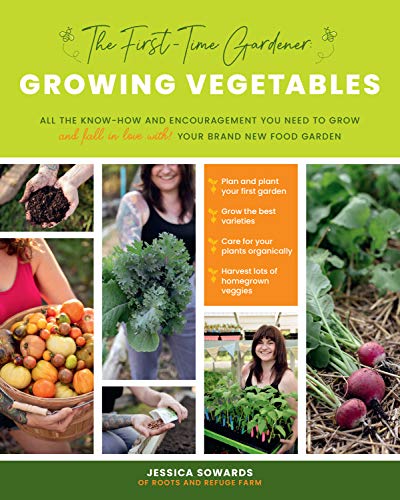
Moving on, I want to recommend The First-Time Gardener to all those who have absolutely zero prior experience of growing vegetables. This one has the basic know-how along with high-energy encouragement to get you going with your new food garden.
Product Highlights
First and foremost, I love how this book is not restricted to only print and has luscious illustrations to keep the readers interested. Are you familiar with the energetic and warm host of the YouTube channel “Roots and Refuge” farm? Well, good news if you like Jessica Soward’s content, because this book is the creation of her beautiful mind.
Next, on reading this one, you won’t only get gardening tips but also tricks to manage your time better and some inspiration to get on the lawn and actually do the job. You might often forget how multilateral gardening is, but the book will give you a fresh perspective to look upon its challenges, satisfactions, and the feeling of accomplishment after growing your own food.
What’s There To Like About It?
The highlight of the book is that it is written in very simple language, without the use of any fancy jargon that you might find difficult to understand. This makes it a piece of cake to go through.
Furthermore, this 176-page long gardening guide is a part of The First-Time Gardener’s Guides series from Cool Springs Press. Each book is aimed at first-time gardeners in different fields (like horticulture, herbs, etc.). Once you’re done with this one and find it helpful, you can delve into other niches.
What’s There Not To Like About It?
This is not exactly a complaint and is more like a general observation. I realized that the book talks about perennial vegetables in more detail as compared to other types. So, if you’re looking for a more holistic approach to all plant varieties, this one might not be your best bet.
Pros and Cons of The First-Time Gardener: Growing Vegetables
Pros
Cons

- Sowards, Jessica (Author)
- English (Publication Language)
- 176 Pages - 03/02/2021 (Publication Date) - Cool Springs Press (Publisher)
3. The Old Farmer's Almanac Vegetable Gardener’s Handbook

Now that’s one hefty name, isn’t it? Well, so is the gardening knowledge inscribed in it by the author. No worries if you’ve never touched a trowel in your life as this book has got you covered right from the basics.
Product Highlights
Focusing on all the aspects of sowing, growing, and harvesting, The Old Farmer’s Almanac gives a step-by-step guide to grow about 30 vegetables in a zone successfully.
While raised beds are a classic go-to move to increase the vegetable yield, this one brings something new to the table. It mentions at length multiple easy techniques to grow in-ground veggies along with some practical alternatives to the OG raised beds.
In addition, even after being a gardening enthusiast myself, I do realize that some of these books can be bizarrely boring at times. But The Old Farmer’s Almanac keeps things light-hearted with its humorous yet enlightening anecdotes and more than 150 vibrant pictures.
What’s There To Like About It?
Among many other things, the book is available in Flexibound illustrated formats, in both new and used versions, at really affordable prices. And I know like me, you book lovers can’t resist a good bargain, so do check out this one.
What’s more, it is packed with essential reference tables and charts, simplified seed-starting and saving methods, and many more scientifically proven gardening techniques. Although its name says “old,” everyone, including green thumbs and old hands, may find it of help.
What’s There Not To Like About It?
The book is surely packed with a lot of integral information, but it’s also the longest one on my list. Any lengthy manual or guide when it comes to a field like gardening becomes a little too much to handle because hobbyists love the practicality of gardening instead of getting stuck with a long theoretical book.
Pros and Cons of The Old Farmer's Almanac Vegetable Gardener’s Handbook
Pros
Cons

- Step-by-step advice for success with more than 30 vegetables in any zone|The dirt on soil: why testing is so important—and how to do it|Easy techniques for growing in-ground plus alternatives to traditional raised beds|Seed-starting and -saving methods simplified|Gardeners’ friends and foes: which plants help (or hinder) vegetables|Enlightening (and humorous!) anecdotes from fellow gardeners|Space for noting observations and experiences|More than 150 full-color photos|Essential reference tables and charts|Much much more!
- Old Farmer’s Almanac (Author)
- English (Publication Language)
4. Raised Bed Gardening For Beginners
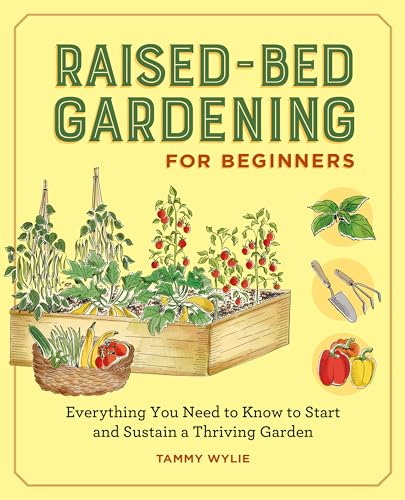
As the name suggests, this one is mainly focused on the raised bed gardening method. Now, this technique takes a lot of time to master, and it’s a wondrous thing that someone wrote a book telling the specifics of it in detail.
Product Highlights
Want to create a bountiful garden in limited space? Then the raised bed method of gardening might be what you’re looking for. The book shows how simple it is to build, plan, and grow your own vegetable garden with raised-garden beds if done strategically.
If you live in a state where it rains a lot, then an elevated garden is a great way to go about your gardening business without letting your plants wilt in the water. Tammy Wylie has thirty years of experience in gardening, and it can be evidently seen in this book.
Additionally, Raised Bed Gardening For Beginners covers essential topics like seed starting, crop rotation, and partner planting. It also has essential tutorials like planter box construction and soil mixing guide.
What’s There To Like About It?
The latest illustrated version is published by Rockridge Press and is available in five different formats. These formats are paperback, hardcover, spiral-bound, kindle, and even an audiobook. Personally, I love audiobooks because they simplify reading so much. I obviously have a hardcover but I recently felt the need to revise my concepts a bit.
So, I purchased the audible version and listened to it while doing my chores and gardening. Other than that, the book is really good if you want clear-cut information on this tried and tested raised bed way of growing vegetables.
What’s There Not To Like About It?
The only downside is that the audiobook is exclusively available on audible. Therefore, if you want to listen to it, you’ll have to take an audible subscription. But the good part is you’ll get a few initial audiobooks for free, and you can avail of this one without having to pay anything other than the registration fee.
Pros and Cons of Raised Bed Gardening For Beginners
Pros
Cons

- Wylie, Tammy (Author)
- English (Publication Language)
- 142 Pages - 07/09/2019 (Publication Date) - Callisto (Publisher)
5. Vegetable Gardening For Beginners

Another one of my favorites without which my top five list wouldn’t be complete is the sweet, short, and simple Vegetable Gardening For Beginners. If you can’t tell mulch apart from mud, you might consider reading this one.
Product Highlights
Perfect for building an ideal foundation, this book has very simple and sorted guidelines for prepping containers, making raised beds, and nourishing soil mixture.
Also, it’s very common to feel confused while picking culinary plants when you’re a beginner. To help you with that, Vegetable Gardening For Beginners has in-depth profiles of plants like cool and refreshing melons, aromatic rosemary, and spicy arugula. These accounts will help you reach a decision sooner.
Furthermore, a garden should have a proper balance between main plants and companion species, mud and mulch, all round the year. This gardening guide will acquaint you with these small strategies to create an ecosystem of sorts in which all the species thrive.
Lastly, it is available in both physical and digital versions, so you get to choose your preferred method.
What’s There To Like About It?
This gardening book has pretty impressive features, one of which is its colorful and appealing front cover. Although they say never judge a book by its cover, I can assure you that the inner content is just as effective.
With Jill McSheehy’s easy-to-follow step-by-step guidance, budding gardeners will be able to get the hang of things in a jiffy. Another thing I loved is that she not only focuses on growing vegetables but also on creating a balanced bio-system in the lawn.
What’s There Not To Like About It?
I found that the zonal map given in the book to pick specific vegetables for a zone is a little inaccurate or maybe a little idealistic. So, I suggest cross-checking the vegetable recommendation with some reliable blog online before going ahead with planting it.
Pros and Cons of Vegetable Gardening For Beginners
Pros
Cons

- McSheehy, Jill (Author)
- English (Publication Language)
- 166 Pages - 04/21/2020 (Publication Date) - Callisto (Publisher)
Buyers Guide
Having discussed all the top picks of the market, let’s move on to the next section of my guide. Here I’ll discuss a few factors that need to be taken care of before you go on to buy a book on gardening.
Since you already know my favorite ones now and the good qualities about them, you must already have a fair idea of what a good book must have. Still, I’ll spell it out more clearly in my handy little buyer’s guide.
1. Level Of Learning
First of all, you need to know what level of gardening skills you are at. Are you just starting out, or have you been at it for a while? Know your learning level and choose a book accordingly.
Some of the books in my guide can be read by both beginners and professionals, while the others are strictly targeted at new learners. If you have some experience yet buy a beginners’ one, things might get repetitive and bore you beyond limits. In contrast, choosing a higher level may confuse you, ultimately making you lose interest.
Hence, it’s important to go through the description of the book and know its level for sure before coming to a decision.
2. Available Formats
Various books are available in different formats, such as physical copies, e-books, and audiobooks. Then, in printed ones, you can choose among paperbacks, hardcovers, spiral-bound, Flexibound, etc. I find paperback to be the best as it is easy to hold, and the pages stay in place too. But then, hardcovers are much more durable and aesthetically pleasing.
If you’re not that keen on getting a physical copy, e-books and kindle editions are more affordable and convenient options. One upside to them is that you can adjust the brightness of your screen and can even read in the dark if you wish to. Plus, it’s much easier to look up difficult words in the in-built dictionary instead of manually searching them.
Furthermore, audiobooks can be heard like a podcast on your earphones while doing other tasks around the house. Ultimately, it comes down to your preference and ease of use, so pick the one you’ll have most fun reading.
3. Length
The total length of the book has a significant impact on its overall readability. While a short guide may have all the important information in crisp points, a long one may give a descriptive account delving into all the details. You can decide which one you like better, but honestly, I find short ones to be much more handy and practical.
4. Niche And Specialization
Another important aspect is to identify the niche topic of the book. I know the broad category that we’re discussing today is vegetables, but there are subcategories in that as well. For example, Raised Bed Gardening For Beginners focuses mainly on one gardening technique. On the other hand, The Vegetable Gardener's Bible talks about WORD at length.
In contrast, The Old Farmer's Almanac Vegetable Gardener’s Handbook has a more holistic approach to gardening. So, you can get an idea of the content by going through the book description and buying the one that interests you the most.
5. Cost
Lastly, you need to stick to your budget as well. If you are willing to pay more, then get a new printed copy. But if you have budget constraints, you can get used books from Amazon or an e-copy at cheaper rates.
FAQs
In my opinion, yes, gardening books are indeed quite helpful. They worked out pretty well for me, as I referred to a few when I started my gardening journey. The reason I recommend gardening books to other people is that they are great for building foundations and clearing basic concepts.
The market is brimming with thousands of books targeted at growing vegetables, so I don’t blame you for feeling confused. It is only natural to feel clueless when you have so many options. Basically, you’ll find three types of gardening books:
A. For beginners
This category deals with an audience that is new to the scene. They cover all the fundamental concepts and start right from the ABC of growing vegetables.
B. Intermediate
These books are relatively a level above the previous type. They might explore deeper into the niche and explain the science behind it. You may find a little jargon in these, so don’t buy them until you are a little confident of your skills.
C. For Experts
As the name suggests, this category of books is for professionals and doesn’t cover the basic know-how. You will get rich and in-depth knowledge in this type.
Yes absolutely! A book will be as good as its author’s knowledge, so it’s a smart move to read about the author before actually purchasing their book.
I’d recommend doing your homework and researching about the writer, checking their experience and qualifications. It’ll save you from feeling disappointed later and might acquaint you with their writing style.
Final Words
Folks, with that, I’ve reached the end of my review-based guide. Gardening books are a great alternative to learn the skill. It’s even better if you’re an avid reader and prefer to do things solo instead of interacting with others and taking lessons.
I hope you found my recommendations on the best vegetable gardening books and buyer’s guide of help. Before wrapping up, I’ll let you in on my favorite picks. I found The Vegetable Gardener's Bible to be the best in terms of skill development.
Other than that, The First-Time Gardener: Growing Vegetables and The Old Farmer's Almanac Vegetable Gardener’s Handbook are competent options to expand your knowledge on vegetable species. And that’s it for me, guys.
I’ll see you next time then! Take care.