
Having a portable generator will make your time camping even more fun. However, the wrong generator can cause you more stress than relaxation.
To make it possible to cool down, recharge your devices, and light up your campsite, you need the best generator for camping.
The key is knowing how to choose the right model to suit your requirements.
You will find a wide array of choices, and many will have overlapping characteristics, so you will need to single out which is better for camping.
Today, you will learn more about the factors that differentiate similar camping generators.
After that, we’ll help you choose which generator will make the most sense for your campground needs.
Best Generator for Camping: Brief Reviews
1. Jackery Portable Power Station Explorer 240
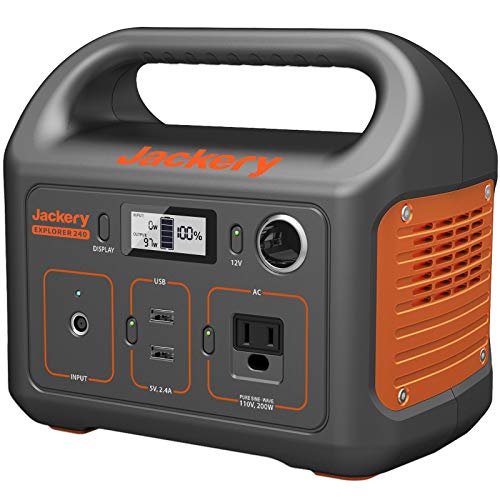
The Jackery Portable Power Station Explorer 240 is a small, portable camping generator perfect for campers with limited power needs.
Product Highlights
Jackery, the company behind this camping generator, specializes in green solutions for campers and adventurers.
Unlike most generators, this generator does not run on fuel or gasoline.
Instead, this quiet generator provides clean power via a 240 watt-hour lithium-ion battery pack.
As long as the generator’s battery is charged up, you can use it on your next adventure.
This power station has one AC outlet, two USB ports, and one DC car port that can be used to keep your devices juiced up.
Once fully charged, the amount of time this unit runs depends on how much power draw it goes through.
If running many devices, it may run out in as little as an hour. When charging something with a very low draw, it will last all night or longer.
The Good
We really appreciate that this eco-friendly power station can be charged in more than one way.
You can charge it in advance from a standard electrical outlet or hook it up to a solar panel.
The Bad
Though this is a solar-powered unit, the actual solar panel is not included with the purchase.
To make full use of it, the panel will need to be bought separately.
Once obtained, however, you will find that it is very functional and useful, especially when camping.
Pros
Cons
2. Generac GP1200i Portable Inverter Generator
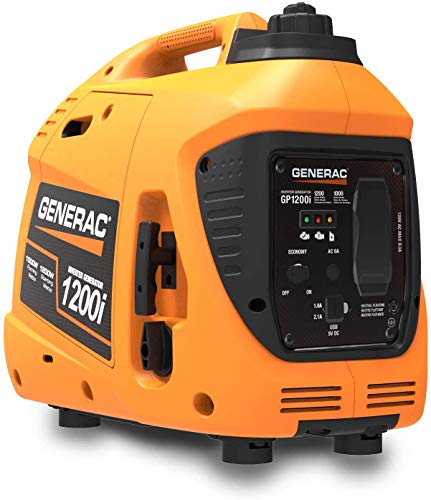
The Generac GP1200i Portable Inverter Generator is an inverter unit that is a great choice for campers with low-end power needs.
Product Highlights
The Generac GP1200i is a portable inverter generator weighing in at 33 pounds.
This unit boasts enough power that delivers 1200 starting watts and 1000 running watts.
This means it will meet the needs of those looking to bring stable power to their small campsites.
The generator features a fully-enclosed design to lower the noise levels, which is great for most camping situations.
It also features True Power tech, a specific set of technology that ensures sensitive electronics and tools are protected.
This model has a built-in handle for easy carrying, too. For even more convenience, there are LED indicators to alert you to important generator changes.
The Good
This generator is outfitted with an economy mode that can help you reduce noise level and fuel usage.
When trying to conserve fuel to create the best camp experience, this setting can be very helpful.
The Bad
There have been some reports of durability issues on the buttons and the case of the generator itself.
Thankfully, these problems are limited in number and are quickly resolved by the manufacturer.
Pros
Cons
3. WEN 56203i Super Quiet Portable Inverter Generator
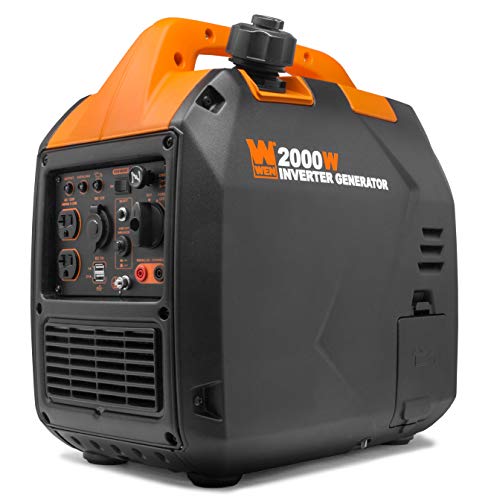
Next up is another inverter generator, the WEN 56203i Super Quiet Portable Inverter Generator. This unit is a mid-range generator for light campers.
Product Highlights
The WEN 56203i Portable Inverter Generator is a 2,000 surge watt, 1700 rated watt generator that is great for camping.
It has an ultra-lightweight body weighing just 39 pounds without fuel. This means it can be easily moved between campsites.
The sound rating on this unit is comparable to the dBa level of a normal conversation, which means it is pretty quiet.
Because it is an inverter generator, you’d find that the power used is classified as “clean power.” This guarantees that it is safe to use, even with sensitive electronics.
Despite being smaller than regular generators, it is equipped with two three-prong 120V outlets, one 12V DC outlet, and two 5V USB ports.
These provide you with more than enough ports to charge and plug in a variety of devices.
Finally, you’d also love to know that this generator comes with a two-year limited warranty from WEN.
The Good
One common problem with generators is their lifespan.
Many burn themselves out because they don’t have the right failsafe in place.
Thankfully, this unit has an automatic fuel shutoff that will ensure any fuel in the carburetor is fully used up before it shuts down.
This prevents the generator from giving out prematurely.
The Bad
Though it has the power rating of a mid-range generator, it lacks some bells and whistles that would improve it. For example, it doesn’t have a watt-usage indicator.
Ultimately, however, this does not detract from the generator’s usability.
Pros
Cons
4. FlashFish 40800mAh Portable Power Station
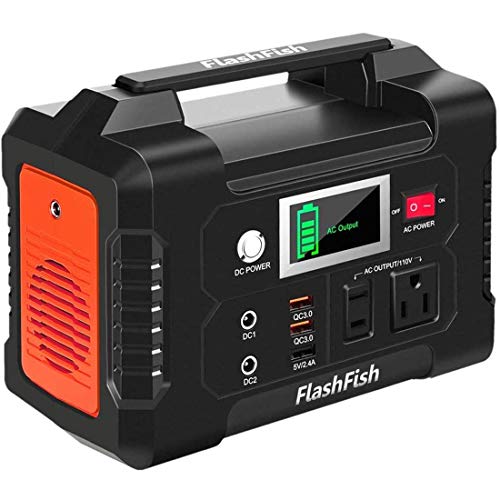
The FlashFish 40800mAh Portable Power Station is a simple battery backup generator that is great for simple campsites and emergencies.
Product Highlights
The FlashFish 40800mAh Portable Power Station is a simple battery backup pack that is great for outdoor adventure trips.
This 200W device is compact yet powerful, and it meets the needs of simple outdoor usage and emergency cases.
This unit has multiple charging outputs. There is a 110V AC output, two DC outputs, two quick-charge USB ports, and one 2.4A USB port.
With all of these different ports, it is easy to power any type of device that fits the power rating.
The unit weighs around four pounds and offers 151 rated watts.
It also has a multi-function, lighted LCD display to give you an idea of how much charge is left and how much output is happening.
The battery pack can be charged with a solar panel (not included), AC wall adapter, or a car charger.
Finally, FlashFish includes a limited one-year warranty with this device.
The Good
This lightweight unit is a fantastic choice for pack-in campers who want to have a power supply for simple equipment charges and emergencies.
Weighing in at only four pounds and easy to recharge with solar panels, this can be an excellent option for backpackers and on-foot adventurers.
The Bad
The biggest drawback of this device is that it is very limited in the power that it holds and the output it can give.
That being said, it is a low-end, affordable power station. It suits what it is designed for, but you should look at higher-end models if you need additional wattage ratings.
Pros
Cons
5. Westinghouse iGen2200 Portable Inverter Generator
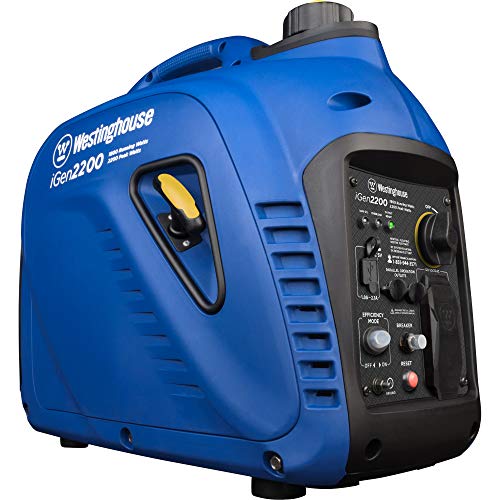
The Westinghouse iGen2200 Portable Inverter Generator is a mid-range model that is perfect for campers who want to power appliances and more.
Product Highlights
This iGen2200 Portable Generator from Westinghouse runs with 1800 rated watts and 2200 peak watts.
Essentially, this means that you can power several small devices at one time, power small appliances, and otherwise make a great camp.
The generator is gas-powered, and the unit is very compact as it measures in at under 20” on all edges.
The iGen2200 weighs 46 pounds without any fuel.
This is a recoil-start generator that runs at 52dBA, which is around the same noise level of most refrigerators.
This unit can run for up to 12 hours at 25% output; it will last overnight for most small campsites.
To power your items, there are two 120V amp outlets and two USB outlets. This lets you easily plug in a variety of devices.
Finally, Westinghouse provides a three-year limited service, labor, and parts warranty with this model.
The Good
This unit is parallel-capable, which means it is possible to easily tie it into another compatible generator to create additional wattage and amperage as needed.
This can be useful when setting up a larger campsite where you don’t want to use a massive generator.
The Bad
One inconvenient part of this unit is that you need a screwdriver to remove the side panel to reveal where the oil and fuel are added.
This can be frustrating at times.
Nevertheless, it is possible to snap the side panel into place without one when necessary, so this isn’t a dealbreaker.
Pros
Cons
Buyer’s Guide
What factors are most important to consider when shopping around for the right campsite generator?
There are a few specific things you should pay the most attention to when making your selection.
For your next portable generator, pay close attention to each of these things.
Make sure that any model you consider will match up with what you want to be able to do while at camp.
1. Generator Type
There are different types of generators, and each type is designed for a specific purpose.
While you can use the generators outside of that purpose, they are optimized to work best in specific situations.
Depending on the kind of camping you plan on doing, some generator types may work better than others.
Recreational Generators
This type of generator is used most frequently by campers because of their small and portable design.
While some larger versions might work with a large RV setup, these are best for small campsites, small RVs, and general recreational camping.
RV Generators
RV generators provide enough power and consistency to run the various RV appliances and features you might have.
These generators are usually permanently-mounted, and they can run on different fuel types.
Standby Generators
These generators are used as power backups for homes and businesses when the power goes out during emergencies.
Towable Generators
Large, towable generators are used for construction sites, concerts, and other large feats.
These are incredibly powerful and large and rely on a trailer for towing.
For camping purposes, you are likely to be focused on finding the right recreational generator for your needs.
Though these are the smallest generators on the list, recreational generators are most optimized for camping needs.
2. Noise Level
When camping, one of the things you are likely to notice right away is the noise level of some generators.
After all, relaxing in nature can be difficult if a loud generator is running in the background.
This is the reason why most campers will try to find a relatively quiet model.
Of course, most will not keep the generator running at all times, but the noise level can still be a problem.
Be aware of how much noise you should expect from the unit you choose to buy.
3. Dry Weight
Camping out means you might be limited on how much weight you can bring along or how much space you have in your campout vehicle.
The dry weight is the generator's weight when it doesn’t have any gas in it.
The smallest and most compact generators do not weigh very much, but some larger 3,000-watt models can weigh more than 20 pounds.
Consider how much dry weight you can easily take on and maneuver easily at the campsite.
If you get something too large to comfortably work with, you might want to look for something else.
4. Power Output
Power output refers to the amount of power that a generator can create based on its wattage rating.
Usually, there are two numbers that you need to consider:
- Maximum power (the maximum output; limited runtime)
- Rated power (the power a generator can make over a longer period)
Lightweight generators are those that have up to 1,000 watts of power. These are great for powering small lights, fans, and TVs.
Larger generators have up to 2,000 watts of power and are suitable for small appliances like microwaves, hairdryers, and heaters.
The biggest models, which come in at over 3,000 watts of power, can power multiple devices at once and large appliances.
Depending on what you want to power at your campsite, most campers will be satisfied with something around the 1,000-watt mark.
If you are setting up a more extensive camp, you may need to upgrade to the 2,000-watt models to avoid any power issues.
5. Run Time
When choosing your generator, you will also want to consider how long the generator can run on a full tank of gas.
The run time is determined by a few different factors:
- Applied load
- Generator efficiency
- Gas tank size
- Type of gas
Often, generators will be advertised with the run times for a full-rated load and a ¼-rated load. Others, however, will only give the ¼-rated load run time.
When investigating different generators, make sure to check the advertised run time to get a better idea of what to expect.
6. Other Features
There are many other features you can also look for when searching for a camping generator.
Add these to your list of desired features based on what you need for your next camping adventure:
- Parallel capability (for when you need more than one generator to work together seamlessly)
- Oil monitor (to automatically shut off the engine when low on oil or fuel)
- Spark-safe (to prevent forest fires from errant sparks in dry areas)
- Circuit protection (to prevent overloading)
During your search, if you come across a unique generator feature you want to try, make sure to add it to your list of requirements.
Generator for Camping FAQs
1. What size generator do I need for camping?
When camping, the size of the generator you need will depend on precisely what you want to hook up to the generator.
For most campers, a small recreational generator will be a great size for your needs.
Generators that are around 1,000 watts will typically be able to provide enough power for your charging and other needs.
If you will be running a camper or another large device, a larger generator, such as a 2,000-watt model, is likely to be necessary.
It is essential that you look at your devices and see exactly what type of power is needed to power them. Then, match your generator to that.
2. How big of a generator do I need for a 30 amp camper?
Since a camper has relatively high power requirements, you’re going to need to get a large-sized generator to adequately power a 30-amp camper.
In this case, investing in a generator able to supply a minimum of 3,000 watts is a must.
If you want to be able to safely run multiple appliances at once or keep the air conditioner running, you will want to upgrade to a 3,600-watt model.
The maximum wattage you will need for this RV size is 3,600; if you want to be safe, go with this size.
3. Can you run a generator overnight?
Yes, it is possible to run a generator overnight. That being said, you need to be safe and smart about doing so.
If you plan to run a generator overnight, make sure that you check all of the following:
- Make sure there is enough gas in the tank to prevent it from turning off prematurely.
- Have the exhaust properly filtered to prevent it from building up in your camper.
- Check that you are permitted to run it at night if camping in a campground.
By doing these three things before you head to bed, you’ll be doing what is necessary to ensure that you and your generator are safe.
4. Is an inverter generator better than other types?
Many modern campers prefer inverter generators over other types, but why?
Inverter generators have a few benefits:
- Lightweight
- Very compact
- Highly fuel-efficient
- Safe for electronic devices such as phones and laptops
- Quieter than other types
Whether or not they are better than other types of generators depends on what exactly you are looking for.
Many modern units are inverter-type generators, and they become even more common with each generation release.
5. How can I make my camping generator quieter?
If you end up with a camping generator that is just too loud to deal with, there are a few ways that you can try to remedy this problem:
- Make sure the generator is on a soft surface to prevent extra noise.
- Point all exhaust away from you.
- Move the generator away from where you are sleeping.
- Buy a quieter generator.
- Create sound deflectors to bounce the noise away.
- Add a muffler to reduce the noise.
By trying some or all of these fixes to quiet down your generator, you’ll find that it is possible to have a relaxing camping experience.
Best Camping Generator: Final Verdict
There are many great generators on the market, but the right unit for your camp will depend on what you are planning to set up.
Once you know how much you need to power and how much dry weight you can pack in, you can start to seriously consider which generator is best for your needs.
The best generator for camping at this time, for us, seems to be the WEN 56203i Super Quiet Portable Inverter Generator.
This unit offers a great blend of size, weight, price, and function. As such, many find that it offers exactly what they need for their campsite.
For those who want something lightweight and easy to carry, the top option is easily the FlashFish 40800mAh Portable Power Station.
This power station is only four pounds. Even so, it provides excellent functionality and value that makes sense for the adventurer who is always on the move.