
However, eating greens as is might seem like a boring thing to do.
Why not juice it up a bit, literally?
There are a ton of juicers available on sale today, from cold pressed juicers to electric ones. Store bought juices carry with them tons of sugar and preservatives, yet give you a fraction of the nutrient goodness.
This guide aims to help you find the best juicer for greens, and answer queries on how to choose a juicer that will satisfy your demands.
So, without further ado, let’s start with a few of the best juicers on the market today.
Best Juicer for Greens
BREVILLE BJE430SIL THE JUICE FOUNTAIN COLD
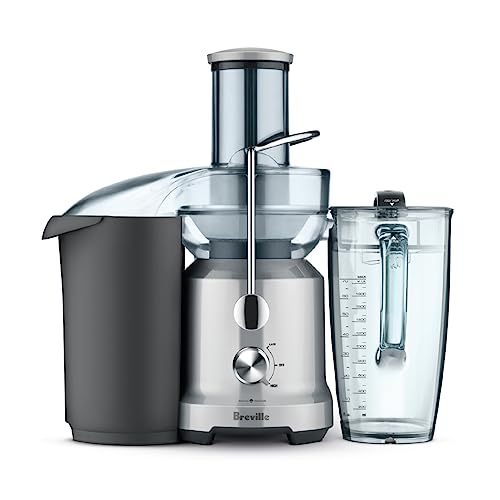
The special seal and store jug gives you the ability to store juice which stays fresh for three days at a stretch. The components are dishwasher-safe, which makes it a breeze to finish juicing up your greens and have it ready for the next day!
For leafy greens, it’s best to go in for a smoothie since a simple juice will require a lot of raw greens. Also, the chunks may be a bit of concern after juicing greens. We recommend saving up the pulp and putting it through the juicer once again!
Pros and Cons of BREVILLE BJE430SIL THE JUICE FOUNTAIN COLD
Pros
Cons
- The Breville Juice Fountain Cold is a high performance juicer with an innovative cold extraction system that can provide a super sized 70fl oz of juice goodness; The juicer's 850 watt motor processes even the toughest fruits and vegetables in seconds
- COLD EXTRACTION SYSTEM: Cold Spin Technology and an Italian-made precision mesh filter allow juicer to avoid causing damage to vitamins and minerals via heat and processing; Utilizing a mix of vegetables and fruits to keep your juices nutrient rich
- REDUCED PREP TIME: Breville juicer's unique 3 inch, extra wide chute feed allows you to juice whole fruits and vegetables without pre-cutting, including carrots, apples, and oranges; Create delicious beverages quickly and easily
BREVILLE 800JEXL JUICE FOUNTAIN ELITE 1000-WATT JUICE EXTRACTOR
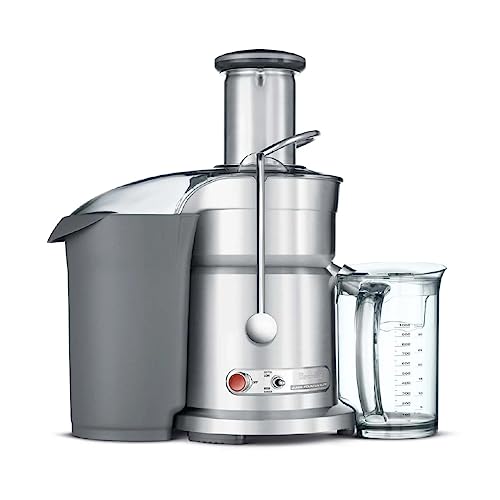
Further, Breville’s Nutri Disc system and patented juicing mechanism efficiently extracts nutrients from your greens. It is one of the best-looking juicers out there, too. The pitcher and waste holder are decently sized for regular juicing.
While juicing, one sometimes notices the juice escaping between the plastic juicer cover and the stainless steel filter bowl surround if it’s done too fast.
Pros and Cons of BREVILLE 800JEXL JUICE FOUNTAIN ELITE 1000-WATT JUICE EXTRACTOR
Pros
Cons
- The Breville Juice Fountain Elite lets you embrace the power of professionals; A 1000 watt motor spins up to 13,000 RPM's to give you up to 30% more juice than traditional juicers; Over 40,000 filtering pores ensure smooth and delicious results every time
- UNIQUE EXTRACTION SYSTEM: The Breville juicers titanium reinforced disc and Italian-made micro mesh filter basket are made out of stainless steel and together are designed for optimum juice and nutrient extraction
- SHORT PREP TIME: The Breville juicer machines unique 3 inch extra wide chute feed allows you to juice whole fruits and vegetables without pre-cutting
THE ORIGINAL HEALTHY JUICER (LEXEN GP27)
No products found.
It took us around seven to eight minutes for the complete process of juicing and cleaning up the model, which is unimaginably quick for a cold press juicer. Due to the cold press nature of the juicer, very little is lost in terms of nutrients or juice quantity.
The spinning mechanism is novel, and gives you fresh juice consistently.
Pros and Cons of THE ORIGINAL HEALTHY JUICER (LEXEN GP27)
Pros
Cons
No products found.
OMEGA J8004 NUTRITION CENTER QUIET DUAL-STAGE SLOW SPEED MASTICATING JUICER

This juicer avoids any sort of foaming due to the novel construction. The Omega 8004 also comes in a white, durable plastic finish which will last you for years. The fact that this doesn’t come with any electrical parts means there is only mechanical wear and tear to worry about, and the warranty is long enough for that to not be a major concern.
One of the biggest advantages here is that leafy greens are dealt with very efficiently. Leafy greens sometimes require other vegetables or fruits to extract the maximum amount of juice in centrifugal juice, while masticating juicers don’t. The Omega J8004 shines in this aspect.
Pros and Cons of OMEGA J8004 NUTRITION CENTER QUIET DUAL-STAGE SLOW SPEED MASTICATING JUICER
Pros
Cons

- Cold Press Slow Juicer: This juice maker machine operates at a slow 80 RPM to minimize heat buildup and oxidation, promoting maximum nutrient extraction and healthy enzymes
- Versatile Kitchen Tool: Turn nuts into nut butter, extrude pasta, grind coffee and spices, mince herbs and garlic, make baby food and frozen desserts, and quickly whip up soy milk with the help of this versatile electric juicer and nutrition system
- Max Flavor and Nutrients: This fruit juicer machine uses dual-stage masticating technology to extract the maximum amount of nutrients, vitamins, flavor and juice from minimal amounts of fruits, vegetables, leafy greens, and wheatgrass
OMEGA J8006 NUTRITION CENTER QUIET DUAL-STAGE SLOW SPEED MASTICATING JUICER

This will be a great addition to your kitchen table of you’re a fan of the chrome finish, which gives an upscale feel to the kitchen as a whole.
This multipurpose masticating juicer can also double up as a grinder for small items, crusher for coffee beans, and used to make baby food as well. The value proposition the Omega J8006 presents is quite strong.
Further, the GE fabricated auger is 8 times as strong as the competition, which is bound to serve you for much longer and deliver more juice from the pulp.
Pros and Cons of OMEGA J8006 NUTRITION CENTER QUIET DUAL-STAGE SLOW SPEED MASTICATING JUICER
Pros
Cons

- Cold Press Slow Juicer: This juice maker machine operates at a slow 80 RPM to minimize heat buildup and oxidation, promoting maximum nutrient extraction and healthy enzymes
- Nutrition System: Turn nuts into nut butter, extrude pasta, grind coffee and spices, mince herbs and garlic, make baby food and frozen desserts, and quickly whip up soy milk with the help of this versatile electric juicer
- Max Flavor and Nutrients: This fruit juicer machine uses triple-stage masticating technology to extract the maximum amount of nutrients, vitamins, flavor and juice from minimal amounts of fruits, vegetables, leafy greens and wheatgrass
BUYER’S GUIDE TO THE BEST JUICERS
Buying a juicer comes with a host of requirements and preferences from your side, and what’s available in the market. Hence, the next part outlines the many varieties of juicers on the market, and reasons why you should give them a closer look.
Types of Juicers on the Market
A variety of juicers are available on the market. To help you decide what suits you the best, here’s a list of the varieties of juicers you can get:
Centrifugal Juicers:
Centrifugal juicers are also popularly called electric juicers. These juicers chop up the fruit or vegetable with a flat cutting blade (much like a blender). It simultaneously spins the produce at a very high speed (of about 3,000 to 16,000 RPMs) to separate the juice from the pulp.
The juice is extracted by the power of centrifugal force.
Pros:
-> Most commonly available kind of juicer on the market.
-> Relatively cheaper for entry-level juicers.
-> Generally have larger feeding chutes.
-> Larger quantities of juice made in one go.
Cons:
-> Losses in terms of juice quality
-> Rather noisy
Masticating Juicers:
These are the hand-operated juicers. These juicers physically crush the internal contents of the greens, thus preserving much more of the nutrition and no heat loss, which protects certain important enzymes.
These come in many varieties such as vertical juicers, horizontal juicers and twin gear juicers. These are manually controlled and have very little in terms of moving components, which makes them much easier to use and to clean.
Pros:
-> Easy to operate and clean
-> Preserves nutrition and enzymes
-> Retains more of the texture of the greens
Cons:
-> Can’t make large quantities of juice at once
Besides the major types mentioned above, there are some other varieties of juicers available too, such as citrus juicers, which are geared specifically for citrus fruits.
Deciding Which Juicer to Buy
Now that you know the different kinds of juicers on the market, here’s a rundown on the kind of juicer you should pick, based on your preferences:
1. How much time do you get to juice?
If you live a busy life and don’t get much time to juice your beloved greens, you’re better off getting a Centrifugal juicer (or an electric juicer as it is commonly known).
If you have time on your side, we suggest going for a Masticating (cold pressed) juicer. The quality gains are appreciable with cold-press juicers.
2. What do you juice the most?
Leafy greens warrant getting a Twin Gear juicer. If you juice harders greens and root vegetables more often, a vertical juicer is the sensible pick. A horizontal juicer can do the job just as well, though.
However, if softer greens fit better into your lifestyle, a self feeding juicer or a vertical juicer is the most sensible pick.
3. How much are you willing to spend?
As a rule of thumb, masticating juicers cost much lesser than centrifugal juicers, owing to the lack of electronic components.
The different varieties of both masticating and centrifugal juicers, such as vertical juicers, twin gear juicers, and citrus juicers are priced across the board. Many similarly priced varieties exist for each kind of juicer, so make sure you do your research.
4. How much juice do you require daily?
If your entire family consumes juice at once, getting a masticating juicer will be a huge time investment. It is better to go in for a centrifugal juicer if there is a greater requirement of juice.
However, if you live alone or it’s just two people consuming juice at once, a masticating juicer will be worth it.
Other Important Factors
Besides the ones mentioned above, you should also consider the following factors:
Feed Chute Size: You should take care of getting a larger chute size if you deal with ingredients which can’t be fed into the chute at once.
The Time it Takes to Assemble, Disassemble and Clean the Juicer: This is extremely important. Your juicing shouldn’t have to kick other things off of your schedule.
The Warranty: Centrifugal juicers require more warranty coverage due to more parts involved and greater probability of parts failing. Masticating juicers do not have as many parts, and hence require smaller warranties (which should be equally substantial in terms of coverage).
The Amount of Dry Pulp Produced as Waste After Juicing: Centrifugal juicers tend to have a smaller juice-to-pulp ratio than masticating juicers. If your ingredients are hard to come by, this becomes a very important consideration.
Frequently Asked Questions
1. Can a juicer make smoothies?
Yes, a juicer can make smoothies. You’ll need a blender too (an all-in-one juicer-cum-blender is recommended).
Peel the fruits and get rid of anything you don’t want ending up in the smoothie (leaves, stems etc.). Slice the fruits and run them through the juicer. Pour the liquefied fruits into the blender, add yogurt and your smoothie is ready!
2. Can a juicer crush ice?
Yes, a juicer can crush ice.
Attach a restrictive grid into your juicer’s grid holder before crushing. Drop the ice into the feed tube. Turn the juicer on and push the ice down through the feed tube using the pusher quickly, lest the juicer’s heat may melt the ice. Done properly, your juicer should eject crushed ice.
3. Can a juicer make soy milk?
Yes, a juicer can make soy milk. However, only a masticating juicer can do so.
Leave two cups of soybeans to soak overnight in approximately half a liter of water. Drain the water and place the soybeans in water, maintaining a ratio of three cups of water to every one cup of soybeans. Run the mixture with a ladle through your juicer and enjoy your soy milk.
4. Can a juicer be used as a blender?
No, a juicer cannot be used as a blender.
A juicer separates the fiber from the juice whereas a blender, as the name suggests, blends all the ingredients together. A blender is best suited for making green, creamy, fiber-filled smoothies whereas a juicer makes, well, juice!
It’s best to buy a juicer-cum-blender to avoid hassle.
5. Are juices safe during pregnancy?
Yes, juices are safe for pregnant women to drink. However, they should be consumed in moderation.
It’s best for pregnant women to consume different juices in moderation. For example, apple juice contains iron which is beneficial for women who are expecting. Similarly, orange juice contains fiber and prevents tooth decay. Spinach juice prevents the occurrence of neural tube disease in the baby.
6. Are juices better than smoothies?
The answer depends.
Juices contain liquids extracted from fruits and vegetables, discarding two-thirds of the dietary fiber in the process, which aids in digestion. The upshot is that normally, the body has to work very hard to process the nutrients but that is not the case with juices, which contain concentrated nutrients.
Smoothies are made by blending fruits, vegetables and liquid into a puree. A smoothie is a meal in itself. Drinking a smoothie is like eating a salad through a straw. Smoothies tend to be heavier than juices and can be difficult for the body to process, making juices better for losing weight.
Ultimately, it boils down to the objective you seek to achieve with the drink.
7. Can vegetable juice help you lose weight?
Yes, vegetable juice can help you lose weight.
The idea behind ‘juicing’ for weight loss is to reduce calorie intake while maintaining an adequate supply of nutrients. As juices are low in calories, juicing makes tipping the calorie balance (calories consumed vs. calories burned) in your favor a lot easier.
8. Can vegetable juice give you glowing skin?
Yes, vegetable juice can give you glowing skin.
Most fruits and vegetables contain anti-oxidants which restrict the development of free radicals, which damage body cells. They also contain nutrients which flush out toxins from your body.
Carrot and beetroot juice is helpful for obtaining a glowing skin. It contains vitamins A and C, iron, manganese and other nutrients, which help you get that radiant morning glow!
9. How do I find vegetable juice near me?
It is easy to make vegetable juice at home with a juicer.
It’s best to buy vegetables locally and prepare vegetable juice using your juicer. It’s cheap, it’s tasty and most importantly, it’s healthy and nutritious!
Wrapping it up
Buying a juicer for greens to live a healthy lifestyle shouldn’t have to be complicated. The article above highlighted the pros and cons of some of the best juicers for greens available on the market today.
We also presented a buying guide to help you know the variety of juicers on the market today, as well as which juicer makes the most sense for you personally.
Now go out there, and enjoy the nutritious goodness of your greens in each and every sip of juice! Happy shopping!