
The kitchen is one of the most renovated parts of the house. It is also among the most expensive to remodel.
Upgrading the sink alone comes with its own set of challenges, like finding the best kitchen sink material.
These materials come in all sizes, shapes, and price points.
Some of them look tough, and they are indeed durable. Others look elegant but are more delicate.
Your choice will ultimately depend on your needs, preferences, and budget.
If you are having trouble making a decision, we’ve got you covered. Here’s a closer look at some of your best options today.
Best Kitchen Sink Material
Whether you are planning a major renovation project or a minor facelift, you would want your kitchen to look its best.
That includes your sink, one of the most used fixtures in this part of your home.
The following materials are the most popular choices among homeowners.
1. Stainless Steel

Stainless steel is king when it comes to kitchen sinks. If you use this material, you pretty much won’t regret it.
It is very durable and resistant to impact and sharp objects.
You can accidentally drop your pans or pots on it, and it won’t sustain any significant damage.
Sharp knives and pointed utensils won’t be able to do much against it either. Other than making loud or irritating noises, no harm will come to it.
In terms of hygiene, stainless steel also performs very well.
With inherent antimicrobial properties, it is easy to keep clean and safe from contamination.
This feature is critical since it is where you prepare your food and wash your dishes.
Finally, even if it is made from metal, it is highly resistant to corrosion and stains.
You won’t have to worry about getting any rust on your dishes or even your food.
When shopping around for this type of sink, make sure that you check out the gauge or thickness of the steel.
A rating of 16 to 18 should be safe, as it is not likely to bend or buckle, even with heavy use.
2. Granite Composite

Granite composite sinks are made from a mixture of granite and acrylic binding resin.
The typical ratio of the two major components is 80% for the natural stone and 20% for the resin.
Although other manufacturers may use a slightly different formulation, it won’t deviate too much from these percentages.
In any case, the resulting material is very tough but also a bit heavy.
So if you plan to use it, note that you need to reinforce the structure of your kitchen counters.
That said, you will find that it is worth it.
Aside from being extremely durable, it is also visually appealing.
It will complement the rest of your countertop and enhance the appeal of your kitchen.
Designed to be non-porous, it is resistant to stains and scratches, and cleaning it is also a breeze.
Just wipe it down with mild soap and clean water regularly to maintain its elegant appearance.
If stains manage to find their way to your sink, sprinkle some baking soda on them, and then add some vinegar.
Next, wipe it down with a non-abrasive sponge and rinse it with warm water.
3. Copper
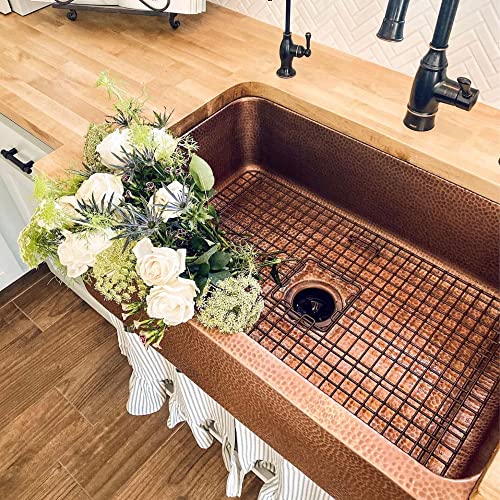
You should consider getting a copper sink if you love a natural patina over bright, gleaming stainless steel.
It is a beautiful and eye-catching fixture, making it a great candidate as the focal point for your kitchen.
Copper sinks come in a wide range of patinas. You can apply a sealer to preserve its original luster or let it develop over time.
Another good option is to get an artisan-crafted sink pre-aged and then sealed.
When shopping around for a copper sink, you can choose between a smooth or a hammered finish.
Note that scratches and dings will be more visible in smooth copper sinks, while hammered ones can hide these imperfections.
Also, like stainless steel sinks, pay attention to the gauge or thickness of the primary material.
If possible, get a 14-gauge copper sink, which is the strongest one available.
There are 20-gauge copper sinks too, but they tend to buckle and bend.
4. Fireclay

Fireclay combines the charm of old-world materials with modern technology and design.
It consists of ceramic clay shaped into a sink and then fired for 40 minutes to dry.
After this, it is coated with enamel and heated at high temperatures for 20 hours.
The entire process makes it durable and highly resistant to stains, scratches, and heat. It also becomes resistant to rust and fading.
This material is an excellent option if you are aiming for a traditional-looking kitchen like the ones in farmhouses.
However, note that while it is durable, it is far from indestructible. Make sure that you do not drop it during installation, as it might crack.
It does not have an iron or steel core that will hold the sink together.
When cleaning it, use a soft sponge to wipe it down with soap and warm water. Avoid using harsh chemicals.
5. Natural Stone

Natural stone is a go-to material for countertops, but did you know it works for sinks too?
Whether you use granite, marble, or lava, you can get a showstopping kitchen fixture.
It is carved from a bigger block of material, so it retains the veining and other unique patterns.
You can rest assured that there is no other sink like it.
Stone sinks are very tough and can withstand practically whatever’s coming their way, like heat, scratches, and dents.
That said, they are very heavy, so you need to reinforce your cabinets and counters before installing a stone sink.
They are also porous, which means you have to apply a sealer once a year or every few years.
Also, do not use acidic cleaners because they can wear down the protective coating and cause irreversible damage.
Another thing you need to remember is that it is one of the most expensive options on the market today.
6. Cast Iron
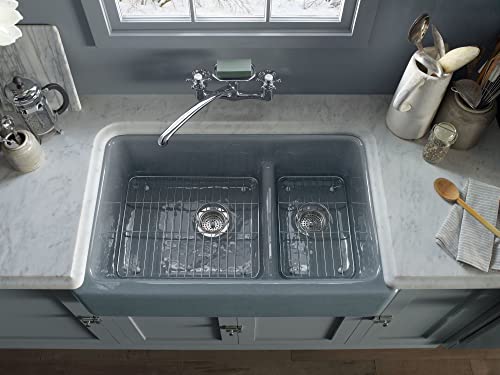
Another luxury material for kitchen sinks is cast iron. Like natural stone, cast iron is very heavy.
Having said that, it is one of the most durable materials you could use for your sink.
You have probably heard of cast iron, and that is because it is commonly used as high-quality material.
However, the ones used in sinks are slightly different.
That is because manufacturers do not leave the iron alloy exposed.
Instead, they cover it with porcelain enamel, which makes it easy to clean and resistant to rust.
If you opt for cast iron sinks, you must ensure that your cabinet is up to the task.
Also, note that it also comes with a hefty price tag.
7. Quartz Composite
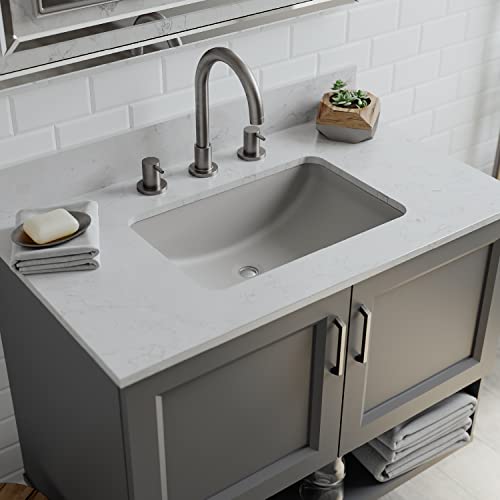
Are you dead set on getting a sink that looks like natural stone but not prepared to pay the full price?
Quartz composites might just be the solution to your dilemma.
This artificial material consists of natural stone bound by acrylic resin.
The resulting product has a very tough surface that is resistant to chips and scratches.
Another thing you would love about quartz composite sinks is that they are non-porous.
Unlike natural stone, which absorbs water and stains, quartz composite is highly resistant to them.
However, be careful when handling delicate dishes because they can break if you drop them on the sink.
8. Solid Surface

A solid surface is made by fusing a mineral compound with polyester or acrylic resin, creating a hard, non-porous material.
It is artificial, and you can get it in virtually any color or design. You can even find one that mimics the look of natural stone.
What makes it unique is that you can seamlessly integrate it into your countertop if it is made of a solid surface too.
You won’t see any joints, which are potential breeding grounds for bacteria.
Note that solid surface sinks are susceptible to extreme heat and can be scratched.
The good thing is that you can sand it down to make it look new again. To make it last, make sure that you dry it after use.
For everyday cleaning, use mild soap and warm water only. You can use a cleaner once or twice every week.
9. Brass
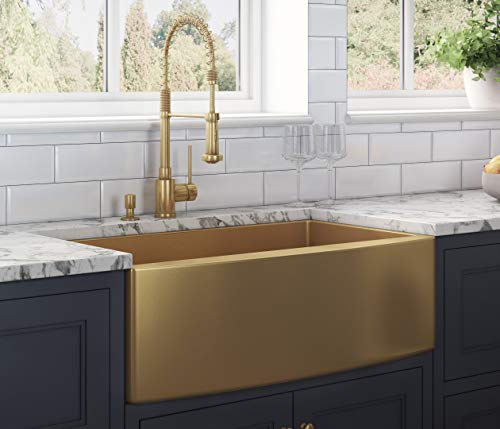
Brass looks a bit like copper, which is expected since it is an alloy of this material and zinc.
It shares the same antibacterial properties, making it a great option hygiene-wise.
Another similar characteristic they share is that they both develop a unique patina over time.
If you do not want this to happen, you also have to apply a sealer to it. Note that brass is a bit tougher than copper.
However, it is still susceptible to the occasional dents, dings, and scratches.
Compared to other options, brass sinks need a little more attention in terms of maintenance.
So if your kitchen is a bit busy, you might be better off with a stainless steel sink or something equally durable.
10. Acrylic
Do you have a particular kitchen design in mind, and you’re not sure what type of sink will match it?
A safe choice would be to get one that uses acrylic as its main component. Acrylic is an easily moldable material that is affordable but versatile.
It is non-porous, which makes it hard for dirt and mildew to build up. However, note that sharp objects may damage it since it is made of plastic.
Also, abrasive cleaners can leave a mark on it.
Take Your Pick
Every kitchen is different, but one thing is for sure: there is a kitchen sink out there for it.
Just make sure you carefully evaluate your needs, budget, and other factors before taking the plunge.
It’s easier said than done, but hopefully, the tips outlined above will help you find the best kitchen sink material.