
Putting the final touches on a staircase can be frustrating if you don’t have the right tools for the job.
In my case, I lacked both the tools and expertise to get my new stairs finished. However, with a little help from my own personal hobby man, aka my husband, I was able to find the right sander for my situation.
It occurred to me just how much of a difference this little tool made in speeding up the process while giving the wood a beautiful, smooth finish. And if you too need a few pointers to find the best sander for stairs, then look no further.
Hi! I’m Stacy Smith, and today, I will review some of the top sanders for you to pick from. You will also find a couple of pointers on how to choose the best one.
With that being said, let’s get right into it, shall we?
Top 5 Sanders For Stairs Reviews
1. BLACK+DECKER BDERO100
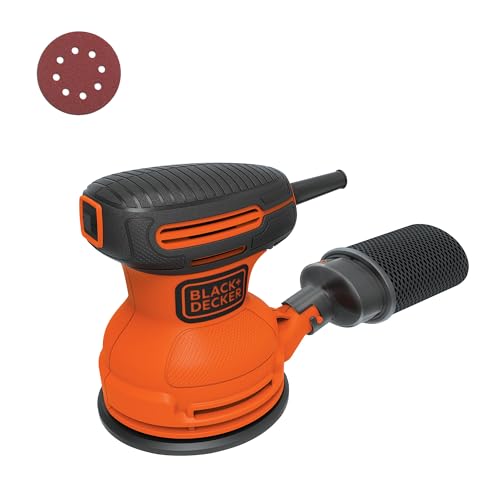
The BDERO 100 from BLACK+DECKER is a compact and lightweight orbit sander that is perfect for use in the tightest of spaces. Not only is it useful, but it is also incredibly functional with a grip handle and dust collection bag.
Product Highlights
Using the BDERO100 from BLACK+DECKER is a great way to create a high-quality finish on any project. It is powered by a two-amp corded electric motor that offers about 12,000 orbits per minute. What’s more, the sander has a random orbit path that eliminates any swirls from coming up on the surface.
Additionally, the attachment system has a hook and loop design, which makes for hassle-free sandpaper changing. Another feature to help make the sander perform more efficiently is a lock-on paddle to keep the workflow smooth.
Furthermore, the sander is easy and comfortable to use. The grip keeps your hands steady and reduces fatigue. Finally, a dust collection bag facilitates the cleanup process that can be done in seconds.
What's There To Like About It?
If there is anything I could change about working with wood, especially at my age, would be the cleanup and maintenance involved. But finding every bit of dust and woodchip is a chore of the past, thanks to the dust collection bag.
I also loved the comfortable grip design, as I could use the sander for hours without getting too tired. It also helped me keep my shaky hands still as I moved them along the wood.
What's There Not To Like About It?
A potential drawback to this sander is the wobbliness in the head that is created as a result of the random orbit path that the sander uses. I found that when I placed the sander on a surface it would feel like the shaft was ever so slightly out of alignment.
Pros and Cons of BLACK+DECKER BDERO100
Pros
Cons

- HIGH PERFORMANCE ORBIT SANDER - 2.0 Amp corded electric random orbit sander for a swirl-free finish
- HIGH EFFICIENCY - Delivers 12000 OPM (orbits per minute) to quickly sand material
- LIGHTWEIGHT & COMPACT - Fits in tight spaces for more versatile sanding
2. DEWALT DWE6411K

With 2.3 amps of power, the DWE6411K fits comfortably in the palm to deliver a powerful performance. An improved paper clamp keeps the sandpaper tightly fitted, while a locking dust-port system cleans as you go about the job.
Product Highlights
Packed full of useful features, this sander from DEWALT is a fantastic addition to any workshop. Working with it is a comfortable experience, thanks to the new reduced height of the sander that allows for up-close passes. There is also a counterweight on the rear end to reduce vibrations, which cuts down on hand fatigue.
Additionally, the sander is incredibly easy to use with the locking dust collection system, which keeps the dust in the tubes and directs it to a vacuum bag. Plus, it’s compatible with both the DWV010 and DWV012 dust collectors, making it truly versatile.
Another improvement made on the DWE6411K is the clamp provided to attach the sandpaper. Better retention and control are just a few of the benefits of this improved system. Moreover, the brand includes a foam pad to create a smoother plane while sanding.
What's There To Like About It?
While using this sander, I found the improvements to the design to decrease fatigue incredibly helpful. These minor adjustments, such as a lower build and rubber grip, helped control the sander better.
Furthermore, the rubber dust boot keeps the dust from entering the power switch. And keeping the internals free from dust can help increase the lifespan of the duster. It also makes maintenance of the tool much more manageable, which is always appreciated by casual users and professionals alike.
What's There Not To Like About It?
Despite being beneficial in cutting down on cleaning time, the dust collection system on this model does not have the best ports. There are potential gaps left in between the actual port and the hose, causing the suction of the attached vacuum to lose pressure. While it is not a dealbreaker per se, it can prolong your work time.
Pros and Cons of DEWALT DWE6411K
Pros
Cons

- 2.3 AMP motor of the electric sander sands at 14,000 OPM
- Rubber overmold texture will provide a smooth and comfortable control while sanding
- Improved paper clamp of the 1/4 sheet sander features for better paper retention
3. Bosch ROS20VSC
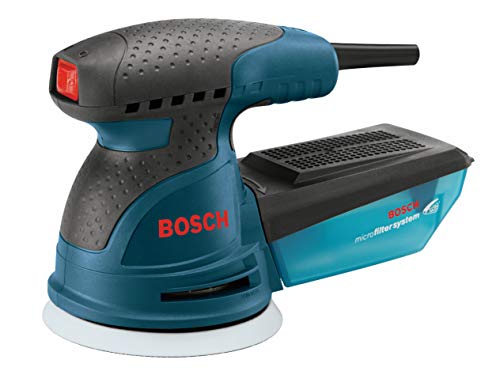
Bosch sanders are an excellent choice for creating smooth finishes without swirls on both flat and contoured surfaces. Powered by a variable 2.5-amp motor, it can be adjusted to match any job you need it for.
Product Highlights
Firstly, the hook and loop disc system on this tool keeps the sandpaper securely fixed onto the sander. Additionally, a dampening system works with it to create a smooth finish across the surface you are working on.
In order to collect dust, there is a microfilter to catch fine dust particles and keep them from entering the sander. The dust canister is see-through to gauge how full it is. Likewise, you can remove it by simply twisting it off. Moreover, it helps keep particles as small as 1.2 microns in diameter from entering the air and being breathed in.
Additionally, the brand has revamped the design of the sander to feature a soft-grip top and body for comfort. Multiple grip positions and angles are now possible, thanks to the palmable design. And the low vibration speed reduces hand fatigue by a great extent.
What's There To Like About It?
Attaching and securing sandpaper to the sander is much easier with the Bosch hook-and-loop system. It has over 35,000 hooks that act like velcro to keep the paper securely fixed.
Furthermore, the rotational speed can be adjusted to match individual tasks. With other sanders, I found that I needed to stop in between when moving from one angle or surface to another. But its adjustment feature is perfect for keeping my workflow going.
What's There Not To Like About It?
One caveat to this sander is the noise level. While it does not take away from the performance, those who are sensitive to noise may find it uncomfortable to use. In fact, for such a small tool, I was surprised at how loud the sander could get.
Pros and Cons of Bosch ROS20VSC
Pros
Cons
- SMOOTH FINISH: pad dampening system designed to eliminate swirl marks on both flat and contoured surfaces
- EASY DISC ATTACHMENT: through Bosch's signature Hook and Loop disc attachment system, sanding pads stick to the hand sander, acting like a Velcro-adhesion material
- VARIABLE SPEED CONTROL: powerful 2.5 AMP motor allows speed to work-piece and task matching with ease; no-load OPM: 7,500-12,000
4. Makita BO4556K

A finishing sander from Makita, the BO4556K is a combination of performance and comfort that is sure to fit into any work tool set. Working at 14,000 OPM, it is a powerful tool to give precise and smooth sanding.
Product Highlights
Bringing comfort to the user is one goal that Makita set out to accomplish with this sander. Sporting a contoured, rubber palm grip, there is an improvement in usability. Hence, users can work for extended periods more than ever before.
Furthermore, a unique dust collection system helps limit the cleaning time. The suction system pulls the sawdust through the pad into the connected vacuum dust port. By pulling directly from the pad, the amount of dust that escapes can be cut down significantly.
Another improvement to the sander’s design is the ball bearing construction. With a countering ball bearing, the body of the sander is able to operate more smoothly with minimal vibration. Noise is also cut down by this precisely engineered ball bearing that makes operation a seamless and efficient experience.
What's There To Like About It?
A feature that I found to be especially useful was the ball bearing within the sander. While it may not be visible, the effect it had on cutting down the noise was exceptional. Moreover, it helped me to hold the tool for longer, as the vibrations weren’t too strong.
Of course, with a rubberized palm grip, I was already able to handle the sander with comfort and ease. All these small factors combined made for a smooth, enjoyable user experience.
What's There Not To Like About It?
An issue that I ran into early on while using this sander was with the dust bag and its capacity. For one, it doesn’t seem to be able to hold much in terms of sawdust. Another gripe I have is its exclusivity with only Makita vacuums. To benefit from the full dust collection system, you need one of their own models.
Pros and Cons of Makita BO4556K
Pros
Cons

- 14,000 OPM for faster and smooth finish sanding
- Precision engineered ball bearing construction for reduced vibration and noise
- Contoured, rubberized palm grip design for improved operator comfort
5. SKIL SR232301
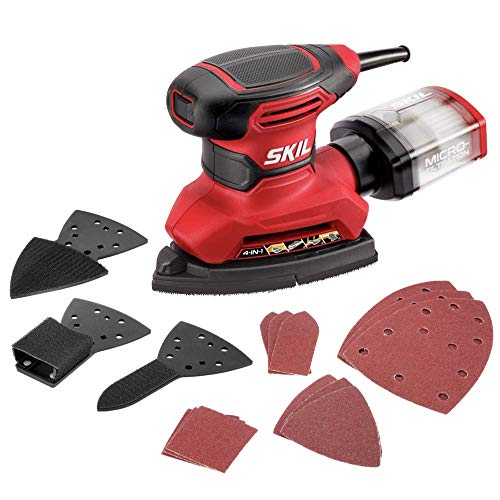
SKIL has designed a compact and nimble sander that has the power and build to finish any surface contour with finesse. A four-in-one sander that operates at 14,500 OPM, this is by no means a tool to be overlooked.
Product Highlights
Versatility is the name of the game with the unique design of this sander. A total of three attachments are included that can enhance its functionality considerably. And depending on the surface or confines of the space you are working on, these attachments can be interchanged to have the best quality result with minimal effort.
For curved edges, SKIL has designed a flexible pad extension that will follow along the contours. Another extension includes a triangular pad extension to get in hard to reach places. In addition, there is a finger extension attachment to aid in reaching narrow surfaces.
No matter the space, there is sure to be an extension that will serve your purposes well. Furthermore, to keep the mess to a minimum, a 1-¼-inch dust port can be connected to a vacuum to suck away refuse. Altogether, this is a great package deal that offers something for everybody.
What's There To Like About It?
Of course, being able to slap on various attachments to the sander was a dream come true, especially when working in tight spaces. Although a palm sander is already great at reaching angles and corners, there are some situations where you may need just a tad bit more.
I have worked for hours on a small corner just because the sander can’t fit. And this is where the attachments come in, giving me that extra reach that I have been missing for some time now.
What's There Not To Like About It?
When I tried to replace the sandpaper on the SKIL sander, I found the Velcro pad to have a bit of an overhang. This can cause swirls to form on the surface-something no one wants on a finished product. It seems that SKIL has designed the tool to be compatible with only their brand of sandpaper, limiting your options considerably.
Pros and Cons of SKIL SR232301
Pros
Cons
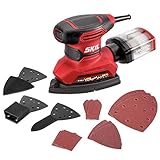
- POWERFUL - With a 1. 2 amp motor and 13,500 orbits per minute, it's able to deliver a smooth performance over a variety of sanding applications.
- VERSATILITY ON THE QUICK - This 4-in-1 detail sander comes with an additional 3 detail attachments for fine finishing large surfaces corners/edges and any surface contour. These attachments are easy to change with no tool needed.
- TOUGH ON DUST - Between its micro-filtration system and the 1-1/4" dust port for vacuum attachment you can choose your preferred way to keep dust away.
Buyers Guide
Before you settle on a particular model, there are a few key points that you should keep in mind. Otherwise, finding the best sander for stairs can easily become a hit or miss situation if you are not careful.
However, not all these factors will be applicable to your situation. Depending on the job and other contextual factors, some features may be more important than others. It is up to you to decide how important each factor is while considering the various models.
1. Durability
One of the most important factors to consider when buying a new power tool is how durable it is. Everything from the build construction to design can affect the durability of the tool. A sander is no exception to this rule and should be thoroughly looked into.
Usually, sanders are made of the same materials, so they are not prone to breaking down as often as other power tools. However, there are some exceptions to this, especially for the cheaper models. If you are looking at budget sanders, then the materials used in its construction should be noted before anything else.
2. Paper Installation
Using a sander is all about being able to rotate the sandpaper at high speeds while maintaining a smooth path. As such, you will find yourself having to change out the sandpaper whenever it becomes worn out. There are a number of attachment styles when it comes to securing the sandpaper to the sander.
A typical attachment style is a hook and loop system that is similar to Velcro. Both a Velcro and hook and loop system have the benefit of keeping the paper flush against the sander. These work well in keeping the paper tight and flat without causing inconsistencies on the treated surface.
Another attachment option is a clamp that simply secures the paper to the sander with a lever. This method has the benefit of being able to easily attach the paper with minimal effort. However, one disadvantage of this design is that the clamp is not as secure as a Velcro system.
3. Power
Once you are sure of the construction of a particular sander, the next vital factor to consider is how much power it can produce. Since palm sanders are meant for minor jobs and are more up-close than other sander variants, you don’t need a lot of power output.
However, there should be enough to turn the sandpaper. Additionally, if you are working with tough surfaces, a low-power model may not be enough to smooth out the material. Insufficient power supply or force can lead to inconsistencies on the sanded surfaces, which you’d want to avoid at all costs.
4. Dust collection system
Incorporating a collection system for sawdust is an industry standard in many modern sander models. While the method of collection changes, the concept remains the same. Collect as much dust as possible while the sander is in operation to limit the cleanup effort afterwards.
Depending on the manufacturer and design of the sander, there are a number of collection methods. Each method has its own degree of efficiency; it is simply a matter of which one works best for you.
A critical factor to keep in mind is whether or not the dust port can be attached to a vacuum. This optional attachment can significantly increase the efficiency of the dust collection system. It also reduces the number of times the dust bag needs to be cleaned out.
5. Counterweight
An optional feature that is included in a few sanders is an in-built counterweight. The purpose of this counterweight is to reduce the noise as well as the vibrations given off by the sander.
6. Rubber-sealed switch
Another optional feature is a rubber sealant that surrounds any open vents or blocks access to the internals of the sander. At the same time, it keeps out dust and debris from reaching the inner machinery and causing a breakdown. Additionally, it helps in increasing the lifespan of the sander by keeping the internals running smoothly.
Frequently Asked Questions
You may have seen an OPM rating on many sander descriptions. This number is how many revolutions a sander can complete in a single minute. The number of orbits per minute, or OPM for short, determines how smooth a sander can make a surface.
With a higher OPM, the sander can be used on more robust materials with minimal effort. However, there are particular materials that may require a slower OPM to preserve the structural integrity. Having a sander with a variable speed setting will definitely come in handy if you are working with a range of materials.
Debris and sawdust flying everywhere is an inevitable occurrence in any project that involves wood. These tiny particles can hang in the air, invisible to the naked eye, until it is breathed in or blown away.
In order to limit the impact of these harmful particles, many sanders have an in-built dust collection system. With an attached filter, it makes sure the smallest of particles, even a few microns in diameter, can’t escape.
Additionally, there is another advantage of this system. You don’t have to spend hours sweeping and hunting for any stray piles of sawdust. Cleaning up after yourself is much easier when all the dust is already stored away in a neat little container you just detach and dump.
My Final Recommendation
Now that you know a bit more about the various sander models available and how to pick the best one, all that’s left is to make a decision.
If you ask me, my all-around choice has to go to the BLACK+DECKER model for the random orbit path that makes the smoothest of finishes. However, a close second is the DEWALT sander that has a great foam pad for smooth finishes and a low height that lets me get up close and personal to the surface.
Depending on how you would like the sander to function is entirely up to you. So, my preferences and needs may not match yours. Search for one that fulfils all your requirements, and you’ll be ready to tackle any stairs.
Till next time!