
Comparing two almost identical welders is no easy task. But if you decide on buying either one, it is necessary to weigh them out.
I understood this the hard way when I was faced with the daunting task of choosing between the Hobart Handler 190 and Lincoln 180 as a present to my daughter for her new workshop.
So, I decided to give them both a try by conducting different tests and pitting them against one another to find out the one that was worth my money. At the same time, I thought of sharing my experience with my readers to help them overcome a similar dilemma.
Hi! I am Stacy Smith, and today I have prepared this guide on Hobart Handler 190 Vs Lincoln 180 to help you understand their strengths and weaknesses. So, without any more delay, let’s get into the deets!
Lincoln 180 v/s Hobart Handler 190: How Are They Different?
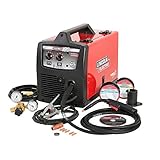
- Precision full-adjustment drive system reduces chance of wire tangling and crushing
- Brass-to-brass gun connections for enhanced connectivity
- Forgiving Arc makes dialing in your application easy
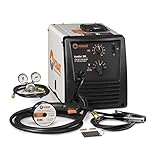
- Welds 24 ga. to 5/16in. steel in single pass
- Powerful and Professional Results. Operates on 230V power
- 25 to 190 output amperage
In order to make a decision about which one to go for, it is essential to know the products inside out. From my experience, I have noticed that both come with their sets of advantages and disadvantages. And in this section, I will give you a quick round-up of their strengths, weaknesses, and what makes them different.
So, let’s take a look.
1. Input Voltage
At first glance, I could not figure out if there was any significant difference between these two devices when it came to the input voltage. But a closer inspection revealed that it is not quite so.
The Lincoln model features advanced technology, which enables it to run on 208V. So, like any other standard welder, you can power it with 230V and also enjoy the special provision of operating it on 208V. That’s why many users prefer this option as it works efficiently even at a lower power supply.
After using it in my workshop, I have noticed that the Lincoln 180 is easier to start, and its arc is much smoother. This reduces the splatter to a considerable extent. On the other hand, the Hobart 190 offers you not one but 7 voltage options, which, in turn, enables greater access and control over the arc.
And if you are using a generator to power the welder, keep in mind that the Lincoln 180 requires around 6900 watts. However, the Hobart 190 will require a minimum of 7000 watts to function correctly (as mentioned on their respective websites). But I have read multiple customer reviews, which state that you can run both these units on generators with a lower wattage.
2. Controls
Using both the devices is pretty simple, given that their operating system is relatively straightforward. There are mainly three things to consider: an on/off switch and two control buttons. One of these switches allows you to modify the voltage settings, while the other helps you control the WFS (Wire Feed Speed).
I prefer working with my gloves on when I work with welders, and I did not have to face any trouble with either of the two models. Even though their controls are a little small, operating with your gloves on won’t be very difficult.
When using the Hobert 190, remember that you can reset the electrical protection mechanism with the help of an on and off switch. Whereas with the Lincoln 180, this feature is not included in the power switch. Instead, it is a separate button that you can find behind the device.
3. Hoses And Regulators
Luckily, both the welders come with a gas hose and an adjustable regulator included in their packages. Both of them also include two gauges and a brass connector that enables you to attach the welders to the gas tank. One of the gauges reflects the gas flow, and the other indicates the amount of gas left for consumption.
When it comes to the Lincoln 180, its Harris regulator works great with Argon and Argon blend tanks. You can also use it to run pure carbon dioxide in case you plan to use a special carbon dioxide tank adapter. But note that you will have to buy this adapter separately.
The Handler, on the other hand, comes with a Miller regulator that works equally well with all types of Argon blend tanks. But as I have read on its website, the brand doesn't recommend using 100% carbon dioxide tanks.
To sum it up, the Lincoln 180 is suitable to run on 100% carbon dioxide, but the Hobart model is not. Since it is quite inexpensive to run these such devices on CO2, many welders prefer the Lincoln over the Hobart.
4. Extras
I do not like spending extra bucks buying accessories when I have already invested in the welders. And both these models have my back when it comes to this aspect. With the Lincoln 180, you get 2 spools of wire and 6 added contact tips in different sizes. The Handler 190 includes an easy-to-use material thickness gauge.
If you are new to welding, the extra contact tips, sets of wire, and a special nozzle provided by the Lincoln will come in really handy.
Final Words
I hope you had a great time learning about both the products. And I also hope that my efforts will eventually help you decide which one to pick.
As I have already said before, both come with their fair share of advantages and disadvantages. The Lincoln 180 is easier to use for beginners and includes a lot of ‘extras’ and an easy-to-use guide DVD. However, if you are looking for better user control, the Hobert Handler 190 would suffice your needs better.
With that, it’s a wrap for today. If you have any queries, write to me in the comments section below. And for more exciting reads, keep a watch on this space.
Until next time, fare thee well!