
Binomial Name: (Glechoma hederacea)
Ground ivy is a broadleaf, perennial, and a sweet-smelling herb in the mint family ”Lamiaceae” and Genus “Glechoma”. Lamiales are creepy flowering plants also known as the Sage family throughout the world. It is one of the essential parts of salad greens in Eurasia, Europe, and North America. Ground-ivy is also dynamic in its elevation range and exists from sea level to over 6000 feet. The Mint family is a species of foothills and valleys where it outcompetes several native plant species for resources.
Origin and Distribution
Ground-ivy is an exotic species that was introduced by the early settlers. Now, it has been naturalized in the north of Mexico and throughout most of North America. Now, it has footprints in all states of the US except Nevada, New Mexico, and Arizona. In the United States, it occurs in all states except Nevada, Arizona, and New Mexico. The basic purpose of bringing this species into the US was its medicinal uses, where it was cultivated in garden beds only. With time it absconded from the garden beds and spread all over the US and Canada. Ground ivy loves shaded habitats in woodlands, hedgerows, roadsides, orchards, ornamental landscapes, and garden beds.
Ground Ivy-Identification
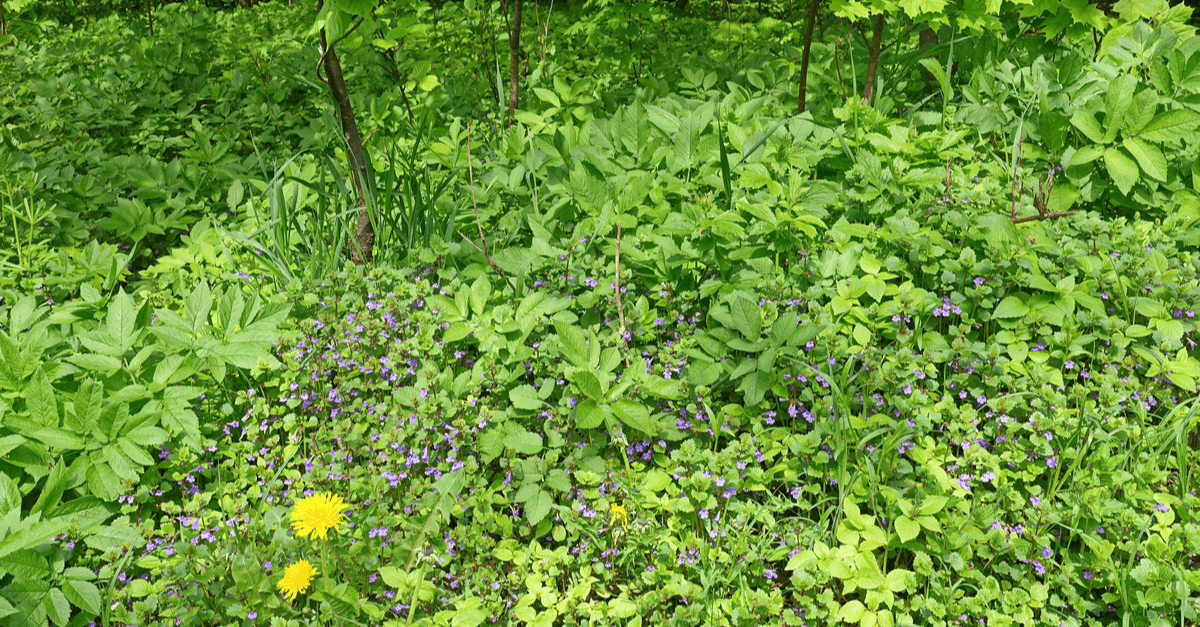
Ground Ivy is a creeping perennial herb that extends by horizontal stolon, which branches from the nodes. Usually, it grows in patches and forms carpet mats. Ground Ivy height varies between 2 to 20 inches, and its stolon could grow as long as 7 feet. An individual ramet produces at the stolon node annually and develops from an overwintering structure that contains 2-true leaves or 8-10 leaves rosette. A cooler climate fever in developing only 2-true leaves. The leaves are often round or kidney-shaped with serrated margins. Flowers are like a funnel, bluish-purple, and pretty small. It usually possesses a fibrous, and shallow root system that emerges from the stolon nodes. The best growing area is damp and bright sunny locations as well.
Ground Ivy- Propagation and Lifecycle
Ground Ivy contains clones with male-sterile flowers. Sometimes, the male-sterile clone may have both males sterile and hermaphrodite flowers. Hermaphrodites produce larger and more flowers. Generally, cross-pollination takes place between Hermaphrodite and female clones flowers. Pollinators also visit flowers, and pollination that takes place by visitors is natural. Ground Ivy produces a huge quantity of viable seeds, usually 4 per flower. Usually, seeds disperse by wind, birds, and animals. Additionally, Ground Ivys' hairy structure helps them in disseminating in air. A few seeds may go into physiological dormancy for a short period. Otherwise, the majority of Ground Ivy seeds are viable and can grow on receiving favorable climatic conditions. Additionally, creeping growth patterns also help them establish the new plants from the stolon, so their propagation in landscapes is faster.
Fun Facts About Ground Ivy
Ground Ivy-Prevention and Control
Cultural Control
Any cultural practice that primarily boosts the health and vigor of your turfgrasses and garden plants would probably suppress Ground Ivy's growth. Keeping in mind that Ground Ivy loves excessive moisture and shades in lawns, trim the trees or shrubs that bring shade to any part of your garden or lawn. Fertilizing a lawn is mandatory besides monitoring that the moisture levels remain optimal. Mowing the turfgrasses to a low height is also beneficial for suppressing Ground Ivy and all other shade-loving weeds.
Chemical Control
Control using Pre-Emergent Herbicide
Roundup Weed & Grass Killer
Roundup Weeds & Grass Killers combines Glyphosate with Diquat Dibromide in 18% and 0.73% ratios, respectively. Glyphosate works through leaf and roots absorption whereas, Diquat Dibromide stops the growth of plants' foliage through burning. Both of these ingredients belong to a non-selective group of herbicides that can be used at or before planting turfgrasses and garden plants given 7- days break after application.

- Power source type: Air Powered
- For use in tank sprayers. For best results add 2 1/2 oz. per 1 gallon of water.
- For use around flowers, shrubs and trees; on patios, walkways, driveways, gravel areas and mulch beds; along fences, edging and foundations; as well as large areas such as lawn replacements or garden plot preparation
Due to a low Glyphosate ratio, the growers need to mix 6 ounces of this product in 1 gallon of water. Otherwise, one quart is enough for 3000 square feet of Ground Ivy infested area.
Control using Post-Emergent Herbicides
Triple Threat Selective Weed Killer
Triple Threat is a selective herbicide that targets only broadleaf weeds without any suppression effects over turfgrasses and narrow leaf plants like cereals, maize, and millets. It contains 2,4-D and Propionic Acids up to 4.55% together. Cumulatively they make 9.1% of the active ingredient in this chemistry. The mode of action is both through roots and leaves absorption. The result is often delayed but kills every target broadleaf weed in 2 to 3 weeks.
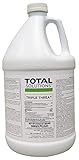
- SELECTIVE WEED KILLER. Our formula targets broadleaf weeds, not grass. You can easily take care of weeds without worrying about damaging your lawn.
- POWERFUL FORMULA. Triple Threat is an industrial strength herbicide. Use it to eliminate weeds entirely after one application.
- EASY TO USE HERBICIDE. Dilute as needed and then spray on the affected area.
Add 1.5 to 2 ounces of Triple Threat in one gallon of water for targeting Ground Ivy. For commercial application, mix one gallon of Triple Threat in 50 gallons of water to spray the targeted areas.
BioAdvanced Brush Killer Plus
Brush Killer Plus has an active ingredient Triclopyr 0.8% only, which means the product contains Triclopyr in very minute quantity and is available in a ready to spray formulation. Triclopyr kills Ground Ivy from the roots after it absorbs through plants' foliage. This chemistry is also tough on hard-to-kill weeds or otherwise, weeds that were resistant to other broadleaf herbicides but, the killing may take 3 to weeks. However, Ground Ivy plants will cease nutrients uptake one week after its application.

- POISON IVY KILLER SPRAY: This herbicide Ready-to-Use spray kills poison ivy, poison oak, blackberry, and over 75 other types of weeds
- KILLS TOUGH BRUSH: Uses a special penetrating formula to kill listed roots and vine weeds, including poison ivy and oak
- WEED KILLER: Start seeing visual results in 1-6 weeks with this Triclopyr herbicide
if a ready-to-use product is available, go straight for spraying on Ground Ivy, Otherwise, add 4 ounces of 8.8% Triclopyr concentrate in 1 gallon of water.
Weed & Feed
The Weed & Feed includes fertilizers and a mix of herbicides that work well on all broadleaf weeds including, Ground Ivy and Crabgrass. Any rotary or drop spreader can evenly distribute this stuff over turfgrasses or in the garden beds. Avoid spillover on vegetables and orchards in beds as the majority of such plants possess broad leaves. In addition to the herbicides, the feed additives boost turfgrasses growth and don’t let supersede weeds. It includes herbicides likely 2,4-D (0.818%), Quinclorac (0.419%), and Dicamba (0.073%) besides 22% Nitrogen and 4% Potash.
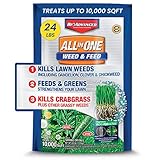
- ALL-in-ONE FORMULA: Now, a weed and feed that also kills crabgrass
- WEED KILLER: Kills listed broadleaf lawn weeds including dandelion, clover, chickweed, and more. PLUS kills crabgrass and other grassy weeds
- LAWN FERTILIZER: Feeds, greens, and strengthens your lawn
A 24 pounds of product can treat approximately 10000 square feet of turfgrasses. Apply at a temperature range between 50-90°F.
Learn How to control and get rid of other weeds in our complete Yard Weeding Guide.