
Scientific Name: (Popillia japonica)
The Japanese beetle is a stout-bodied beetle that belongs to the family Scarabaeidae in the Genus Popillia. The Scarabaeidae family contributes to more than 30000 species of scarab beetles worldwide. The scarabs are often with bright metallic colors and typical clubbed antennae composed of lamellae plates which, helps them to sense odors. It's controlled with predatory insects in Japan but, in North America, it is a pest of serious concern that spoils over 300 species of fruits, ornamentals, and turf grasses. The plants' foliage affected by such beetles appears like a skeleton whereas, the entire leaf tissues are eaten, and veins remain intact with the plants. The larva of the Japanese Beetle lives and feeds on the roots of the ornamental and landscape grasses.
Origin and Distribution
The Japanese beetle has ancestries in Japan, and the first case of its appearance was reported in southern New Jersey in 1916 in the United States. The Japanese beetle is an invasive pest of serious concern in the Eastern U.S, where it causes substantial damage to fruits, vegetables, shrubs, and trees. Its pervasiveness is more critical in the regions of moderate precipitation and temperature. Agriculture Extension services report it as the utmost detrimental pest of the metropolitan landscapes in the Eastern U.S. since this region provides an adaptable climate for developing grubs in turf grasses. Additionally, hundreds of host plants are available that feed them during the later stages of their growth. Otherwise, Japanese beetle expansion is also significant in Ontario, Minnesota. Iowa, Missouri, Arkansas, Georgia, and Alabama.
Japanese Beetle- Identification
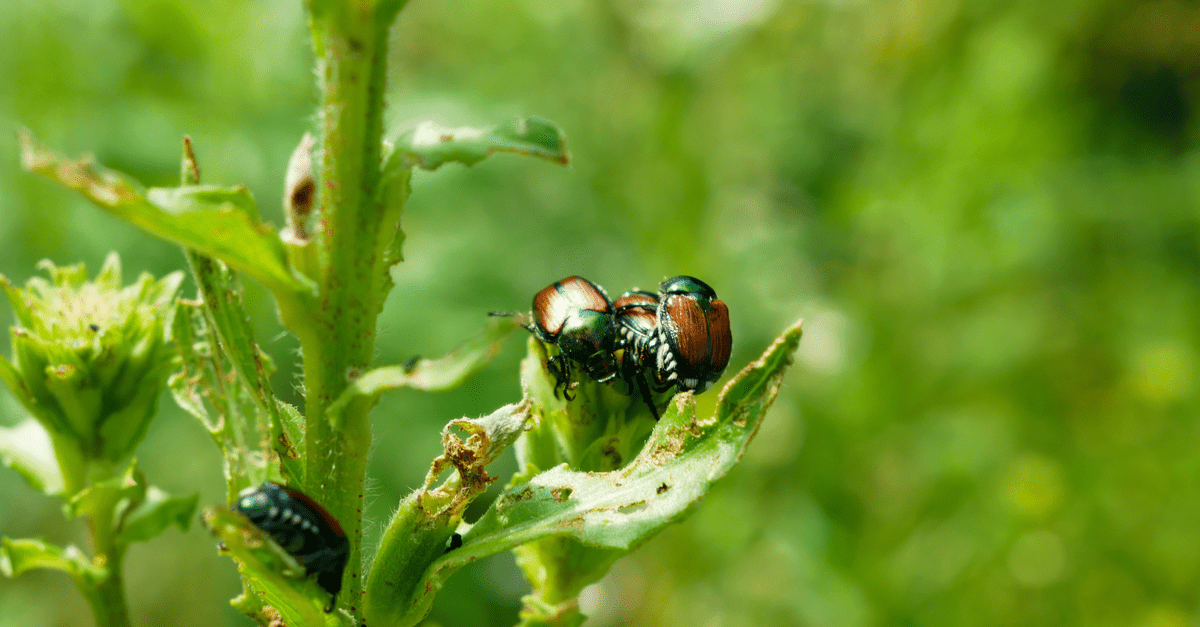
A mature Japanese beetle possesses a shiny iridescent copper body, metallic-green thorax, and a head. Usually, it measures less than half of an inch in length. The wings cover is coppery-brown, and pair of these wings rests on the back of its body. The posterior body margins also contain tiny patches of white hairs. Males and females appear similar, but females are a bit bulky than males. Newly emerged larvae are similar to white grubs and possess a C shape, white body that could measure about one inch in length. Japanese beetle larvae have a close resemblance to the June beetles.
Japanese Beetle- Lifecycle
Japanese beetles usually observe only one generation in a year. Adults emerge in mid or late summer. They are hyperactive in the afternoons of warm sunny days. Mating takes place during this period and female goes down 3 to 4 inches in the soil that contains rich moisture, and plenty of organic matter. Such hidings are usually available under turfgrasses and mulch of the garden beds. Japanese beetle lays Eggs under these hidings that would hatch in 12 to 15 days depending on the temperature and moisture. The grubs start feeding on roots of the grasses and other available plant roots. They're fully mature in autumn and move further deep into the soil as the temperature begins to drop. The feeding stops, and they turn out to be sedentary when the temperature drops below 50°F. Again in Spring, when the temperature rises above 50°F, the grubs bore upward and pupate to transform into an adult.
Symptoms and Types of Damage
Japanese beetle adult feeds on leaves and flowers of several plant species, including fruit, vegetables, shrubs, weeds, and ornamentals. Whereas they prefer to feed on apple, plum, rose, and grapes foliage consuming only the soft tissues while sparing a skeleton behind. Their feeding starts from the top of the foliage and gradually down. Extensive damages turn the branches brown and shedding from the plant starts. Whereas, a grub keeps feeding on the turf's root limiting its ability to absorb water and nutrients from the soil. As a result, bad patches appear in the turf.
Where do they come from?
Japanese beetles emerge from the soil as an adult when the temperatures reach above 70°F. Their movement from deep soil starts when the temperature starts exceeding 50°F, and they become fully active when it ranges between 85-95°F. Japanese Beetles' feeding activity remains at the top from mid-noon to afternoon provided the humidity levels are also promising (60% or above). Their damages may reach destruction when high humidity hinders their flying ability. Similarly, the females can only lay eggs on the available wet soil. However, extremely hot and dry conditions could probably check their infestations and damages together.
How to Prevent Japanese Beetles?
If all preventive measures and cultural controls fail, adopt any controlling methods listed below, which include organic, natural, and pesticides controls for the effective management of Japanese Beetles.
How to Get Rid of Japanese Beetles
Biological Control
St Gabriel-Milky Spore
Milky spore, Paenibacillus popillae is responsible for causing disease in Japanese beetle grubs and may not be effective on other grub species. The larval stages of Japanese beetle are susceptible to Milky Spores that directly ingest through their mouth. These spores reproduce within the body of the host and kill them eventually. After killing a host, they disperse into the surrounding areas. One application may last for ten years or more, and there is no harmful effect on humans and the environment. Milky spore application does well when your lawns are readily watered, or if it rains before or immediately after that.

- 20 LB
- Covers 7000 SQFT
- Milky Spore Grub Control Spreader Mix
The gardeners may apply it with a spreader. 20 Pounds of Milky spores are enough to cover 7000 square feet of turfgrasses and garden beds.
Natures GoodGuys-Beneficial nematodes
It contains 5 million nematodes Heterorhabditis bacteriophora which, are most effective against Japanese beetles and grubs of several other species, including European chafers. They are more competent than any other naturally occurring nematodes. They are habitual burrowers and go deep down in the soil in search of their prey and use specialized teeth for capturing Japanese beetles. Nematodes are often marketed and shipped alive and can be kept for 2 to 3 weeks in a refrigerator. The best application time is weather-dependent and the number of Japanese beetles present at the time of application. However, mid to late summer is fine as the grubs remain active during this period. The mode of action is entering the host stomach, spiracles, or anus and releasing a fungus that kills the grubs.
No products found.
Five million nematodes cover over 2000 square feet of turfgrasses to target Japanese beetle’s grubs.
Organic Control
PyGanic Botanical Insecticide
It contains 1.40% Pyrethrins which, is a botanical insecticide and derived from chrysanthemum flowers. Pyrethrins themselves consist of six different chemicals that are highly toxic to most insect pests, including Japanese beetles, whiteflies, and aphids. PyGanic is an OMRI-listed product that is the first choice of organic gardeners. Additionally, the gardeners can apply it on edibles to the day of harvest.

Add 1 to 1.5 ounces of product per gallon of water, depending on the types of infestations.
Bonide Japanese Beetle Killer
Bonide Japanese Beetle Killer is another botanical insecticide that contains 0.20% of Pyrethrins besides having 0.20% of Piperonyl Butoxide which, is also an organic compound that enhances the efficacy of insecticides when mixed in liquid formulations. This product can be used on a variety of plants, including vegetables, fruits, and roses, without fear of any residual effects in greenhouse culture and outdoors.

- BUG KILLER - This spray controls Japanese Beetles, aphids, flea beetles, leafhoppers, caterpillars, stink bugs, moths, Colorado potato beetles, webworms, & more.
- FOLIAGE PROTECTOR - Our pest control is great for use on vegetables, flowers, ornamentals, trees & shrubs.
- INDOOR & OUTDOOR USE - Japanese Beetle Killer is intended for residential use indoors, outdoors, or in greenhouses.
Bonide Japanese Beetle Killer comes in a ready-to-use formulation. Use directly on the foliage of the plants instead of targeting adult beetles.
Chemical Control
Bonide-Insect Control Systemic Granules
Insect Control Systemic is 0.22% Imidacloprid ready-to-use granules that can be spread easily. It could provide Japanese Beetles and other flying insects control for up to 2 months during an active growing period. The gardeners can only apply it on non-bearing shrubs, trees, and roses since Imidacloprid residuals effects could sustain up to 85 to 130 days in the soil. However, residues found in vegetables and fruits may have a shorter length.

- Protect plants from insect damage with Systemic Granules for Insect Control from Bonide; this product is a low odor ready-to-use solution for outdoor plants
- Protection lasts for up to 8 weeks after application; the granular treatment is absorbed into the roots and continues to move through the plant to provide protection against listed insects; this protection will not be washed away with water
- Product kills insects such as mealybug, aphids, scale, and more through ingestion; this product will not harm insects that do not feed on plants
After broadcasting granules on the soil surface, do water your lawn and garden beds heavily.
Sevin Concentrate Bug Killer
Sevin is 22.5% Carbaryl, a highly concentrated and toxic formula that kills Japanese Beetles and several other suckings, crawling, and chewing insects that harm vegetable gardens, orchards, and lawns. Carbaryl is highly toxic and may have prolonged residual effects on edible gardens.

- Squeeze & Measure. No Mess!
- Kills Japanese Beetles
- A little goes a long way. A really long way!
Never exceed mixing 1.5 ounces per gallon of water to target plants’ foliage, tender shoots, and stems.
Read the label, safety data sheet, and precautions before a purchase.
Check out our other guides on common garden bugs.