
Doing some DIY work requires many different tools, such as the basic sets and a circular saw when cutting something.
Every circular saw has a specific blade size, so it’s a bit difficult to use if you’re cutting small things.
It’s why a lot of DIYers ask the question: "Can I use a smaller blade on my circular saw?"
Let’s have a closer look at the possibility of using a smaller blade on your circular saw and the different types of blades that you can use.
Can I Use a Smaller Blade on My Circular Saw?
Yes, you can use a smaller blade as long as it has the same pattern and design.
That said, there are other things to keep in mind when ensuring your safety and protecting your tool from damages.
They will also make sure you accomplish your task efficiently, leaving you with precisely cut materials.
Important Considerations
Below are a few tips and tricks that you need to do before choosing a smaller-sized blade and cutting a material using it.
1. Read the Manual
Every circular saw has detailed instructions on the size of the blade that you can use.
Undoubtedly, it will be your best guide when choosing a blade for your circular saw, whether that may be the specific type or size.
It will help you determine if a smaller-sized blade will fit perfectly on your circular saw.
The general rule is to never use a blade with a size lower than the one recommended by the manufacturer.
2. Consider the Blade's Use
Yes, smaller blades can fit your circular saw, but can you use your tool properly?
With that said, you need to consider the type of material you’re going to cut.
The circular saw might accommodate the blade size, but the blade itself might not be as effective when it comes to cutting the material.
Also, always take note of the cut that you want to do before using a particular blade.
Some blade sizes won't be able to create the type of cut that you want to achieve.
The type of cut will also tell you exactly the blade type that you need to use.
3. Always Adjust Settings
You always have to prepare for the reduced cutting depth once you use a smaller blade.
Make adjustments where necessary since the original settings would surely not be applicable for some materials.
That is especially when cutting large materials with smaller blades.
What Are the Different Types of Circular Saw Blades?
As you've noticed above, the blade size is just one factor when using a circular saw.
You also need to know the different saw blades that you can use.
Learning what blade to use for a project can make or break your material-cutting experience and result.
Below are some of the common blades that you can use for your circular saw.
1. Ripping Blades
The best type of circular saw blade that you can use to rip hardwood is a ripping blade.
It is made specifically to cut along the wood fibers so it will leave a cleaner edge.
This type of blade usually has around 14 to 24 teeth.
It also has a deeper gullet, which would allow it to handle many materials for rip cuts.
If you need fast and rough cuts, this blade is your best option.
2. Crosscutting Blade
You will cut through many wood fibers with a crosscutting blade, so it is harder than rip cuts.
A crosscutting blade has a lot of smaller teeth and a shallow gullet, which results in a cleaner cut.
Crosscut blades can also generate more friction when cutting wood since they have more teeth.
They also cut longer than rip cutting.
These blades will also have less wood, leaving a very smooth finish in the end.
That said, since the blade cuts slowly, it has a higher chance of leaving burn marks.
3. Plywood Blade
Plywood is known to chip and splinter easily, so the best type of blade for cutting this type of wood should have more teeth.
A plywood blade usually has 40 or more teeth.
It is made for fine materials since it can help minimize splintering on the wood while you’re cutting it.
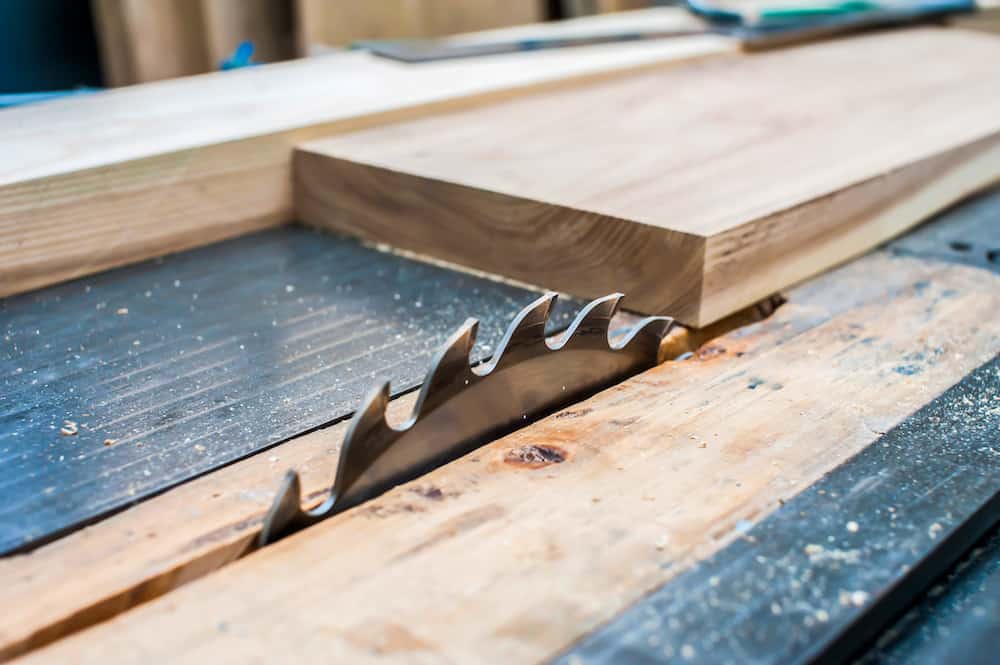
4. General Purpose Blades
As the name implies, you can use this type of blade for a wide variety of cutting tasks.
It may not be as fast as ripping blades when cutting wood and not as strong as crosscut blades, but it will get the job done.
5. Finishing Blade
You use a finishing blade to provide a smooth and clean cut on the surface of the wood.
If a particular part gets exposed when the job is done, you need to use this blade.
This type of blade comes with a lot of teeth and can cut wood without damaging it.
6. Thin Kerf Blade
The term “kerf” actually refers to the width of the cut.
Thin kerf blades are designed for making narrow cuts on the wood and cutting dimensional lumber.
Always remember that a thin kerf blade is not usable on tougher wood.
Since it’s very thin, it will surely flex, making it very difficult to cut the tough wood in a straight line.
7. Masonry Blade
If you look at a masonry blade, it is completely different from your usual woodcutting blades.
It is because this type of blade doesn’t have any teeth.
Masonry blades cut through stone, brick, ceramic, and other masonry materials.
You can use this type of blade in different applications like tile work and precision cutting.
The blade comes in different sizes and can be made from various materials to fit a more specific usage.
8. Dado Blade
This specialized blade is the best option if you plan to cut rabbet cuts, grooves, or dados.
You often use this for interlocking applications.
It is a good option if you make drawers, door panels, cabinets, bookshelves, and more.
What Are the Different Types of Circular Saw Blade Teeth?
Once you’ve already known the type of blades you can use on your circular saw, it is best to understand their teeth.
The difference between these blades is usually found in the number of teeth that they have.
The teeth have a significant impact on the final result.
Below are some of the teeth that you can find in a circular saw.
1. Alternative Top Bevel Teeth
This type of teeth has a bevel design, which would help when alternating between right-hand and left-hand bevels.
For this type of teeth, crosscut blades would benefit greatly, while you can also use it for light rip cuts.
You can use it for natural woods since it can handle the toughest material.
2. Negative Hook Angle
For this type of blade, miter saws and radial arms would be a perfect choice.
The tip of the teeth flanks backward and slows the feed rate.
It can also reduce the chance of kickback when using the circular saw and make the blade safer for the user.
3. Nail Resistant Teeth
If you plan to demolish tough material, these are the best teeth to use.
It is often called demolition lumber because you can see this type of blade on most construction sites.
The blade is extremely tough that it can even break a typical saw blade.
Made with a softer carbide, this blade can easily absorb the shock.
How To Choose the Type of Blade for your Circular Saw
You need to know how to pick the right blade for your saw to ensure you pick one that will work efficiently.
Below are a few tips that you can consider.
1. Type of Materials
As mentioned, when choosing a blade for your circular saw, you need to know the type of material you’re going to cut.
There are specific blades for metal, wood, and plastic materials, so make sure that you already know what type of material you’re going to work with.
2. Type of Job
You can also choose a blade based on the job you’re going to do.
You can get a blade that you can use for several jobs, like a general-purpose blade.
But, if you need a more specified cut, you can use a specialized blade intended for a specific job.
Choose wisely as it would affect the speed and efficiency of your work.
3. Type of Cut
There are different types of cuts that you can do with a circular saw, but it would depend on the type of blade you’re using.
You can make rough and fast cuts with a ripping blade, smoother and more precise cuts with a crosscutting blade, and more.
Final Thoughts
So, can I use a smaller blade on my circular saw?
Yes, if you don’t really mind the efficiency and speed of the cut that you’re going to do.
Although you can put a smaller blade on the saw, it doesn’t mean that you can use it properly.
It’s better to learn about the different blades you can use for your circular saw to choose which one will fit you best.