
One of the age-old tools used in manufacturing is a hammer. But there’s still so much confusion around which ones to include in the toolshed.
Once you start looking for hammers on the market, you would be surprised with the variety that humanity has developed over time. With my children shifting to other states, it fell on me to repair every little thing that required fixing in the house. So, I started to research and increased my knowledge on what are the different types of hammers and uses.
My friend Rhonda has been asking me to share my knowledge with her for a long time now, and I thought, why not design a guide for all my readers? Hi! I am Stacy Smith, and I have curated this guide where I talk about the most common types of hammers and their uses.
So, without any more delay, let’s dive right in.
Common Types Of Hammers And Their Purposes
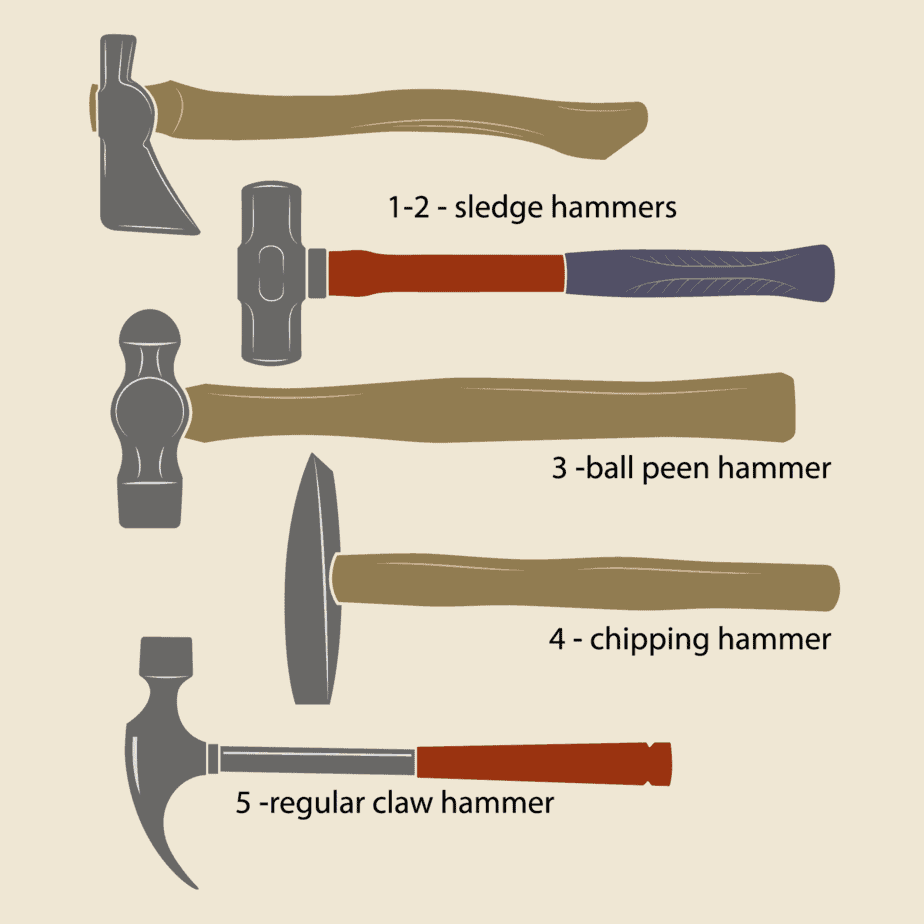
In this section, let’s take a look at some of the most useful types of hammers that you will find on the market. And it’s quite possible that you already own a few of them. But if you haven’t bought one yet, I can say with certainty that they will make for useful additions to your tool shed, no matter how big or small the project is.
1. Claw Hammer
This is probably the most recognizable type of hammer. In case you are a fan of horror movies, then you cannot have missed its screen presence! Jokes aside, this option is great for levering out nails. It comes with a curved and forked claw that is highly useful in gripping the heads of nails.
What makes this hammer a favorite for homeowners (including me) is the versatility it brings to the table. It is so useful that you can literally find it in every workshop and residential toolkit.
2. Rubber Mallet
If you do not know what a mallet is, let me break it down for you. It is like a block placed on a handle, which is mostly used for making chisels. It goes without saying that a rubber mallet comes with a rubber head.
When you are working on a project where you cannot use a metal head hammer, this type can be of great help. You can get the work done without creating any impact marks. The most common uses of rubber mallets are on plasterboard, for fixing wooden parts, and in shaping metal.
3. Welder’s Hammer
When buying a welder’s hammer, remember that its most crucial element is the handle, which is what makes it stand out. In fact, you would be surprised to know that it is made with a barrel spring, which is highly resistant to heat.
So, rest assured that the handle will never get too hot for you to hold, even when you are working for prolonged periods in warm outdoors. And there’s another advantage- the head is designed in a way that it works efficiently for chipping purposes.This is why some people also call it the “chipping hammer.”
However, these hammers are quite effective for other tasks as well, and especially for removing slag.
4. Framing Hammer
Framing hammer belongs to the claw hammer family, and I always see a close resemblance between these two. It comes with a waffled head and a straight claw, and as the name suggests, its primary function is to assemble and help in installing house frames.
The waffled head does a great job to prevent slippage as you drive the nails in the walls. There is always a chance that it might cause some amount of damage to the surrounding walls, but there’s nothing to worry about. Once the construction work is over, none of these marks would be visible anymore.
5. Sledge Hammer
Whenever I use a sledge hammer, the first thing that I notice is its size. Plus, it comes with a mallet-like head and a long handle. It’s designed this way so that users can hold it with both hands to apply maximum force on the work surface. Not only that, but some of them can also weigh up to 16 lbs.
A sledge hammer is primarily meant for heavy-duty work and can be used for demolition activities such as breaking stones. They can deliver a mighty blow and are good for driving stakes too.
6. Drilling Hammer
The best way to think of a drilling hammer is to consider it as the baby sister of a sledge hammer. Many people also refer to it as the club hammer or the engineer’s hammer. This variety offers the same kind of utility as that of a sledge hammer but on a much smaller scale.
I find drilling hammers to be pretty lightweight and compact, so using them even for a long time does not strain my hands or shoulders. They are easy to carry in one hand and are highly portable because of their build and weight.
If you want to accomplish any chiseling work or small-scale demolition job, then I’d strongly recommend choosing a drilling hammer.
Final Words
You must remember that every hammer comes with a purpose or use, so make sure you pick the one that will best fulfill your needs.
And while you stock your tool shed with a plethora of hammers, make sure to take proper care of them. I am guilty of being a hoarder, but I make sure that I take good care of my equipment to ensure that they retain their functionality for a long time.
When you take care of something, it takes care of you. And hammers are no different. So, proper storage, cleaning, and regular maintenance are necessary to get the maximum out of them.
On that note, it’s a wrap. If you have any queries, make sure you write to me in the comments section below.
Until next time, adios!