
Binomial Name (Senecio vulgaris)
Common Groundsel is a ruderal species in the flowering family “Asteraceae” which is an annual broadleaf in the Genus “Senecio”. Generally, Common Groundsel is a winter-pervasive herb. But, it grows all year round in a coastal climate. It's a type of plant species that is the first to infest disturbed areas and agricultural lands. Common Groundsel is seen growing from the sea level to 1500 meters' elevation other than deserts. But, the invasion is most common during cool and moist conditions, while it dies in hot and dry weather. There is evident proof that it contains Pyrrolizidine alkaloids which are toxic for both humans and livestock. These alkaloids are naturally occurring compounds, and Groundsel produces them to strengthen their defense mechanism against the invasion of insect pests.
Origin and Distribution
Common Groundsel traces its origin back from Northern Asia, Europe, and some fragments of North Africa. However, its origin is unclear and controversy is seen in the statements made by both USDA, GRIN, and ITIS. USDA also thinks that is native to Greenland, Canada, and all 50 states of America. On the other hand, the United States Geological Survey declares it exotic to both US and Canada except for 4 Canadian regions. Now, the Groundsel dominates garden beds, nursery plots, landscape facilities, and disturbed sites throughout the US. However, Groundsel is not as such a problem in turfgrasses as considered.
How to Identify Common Groundsel?
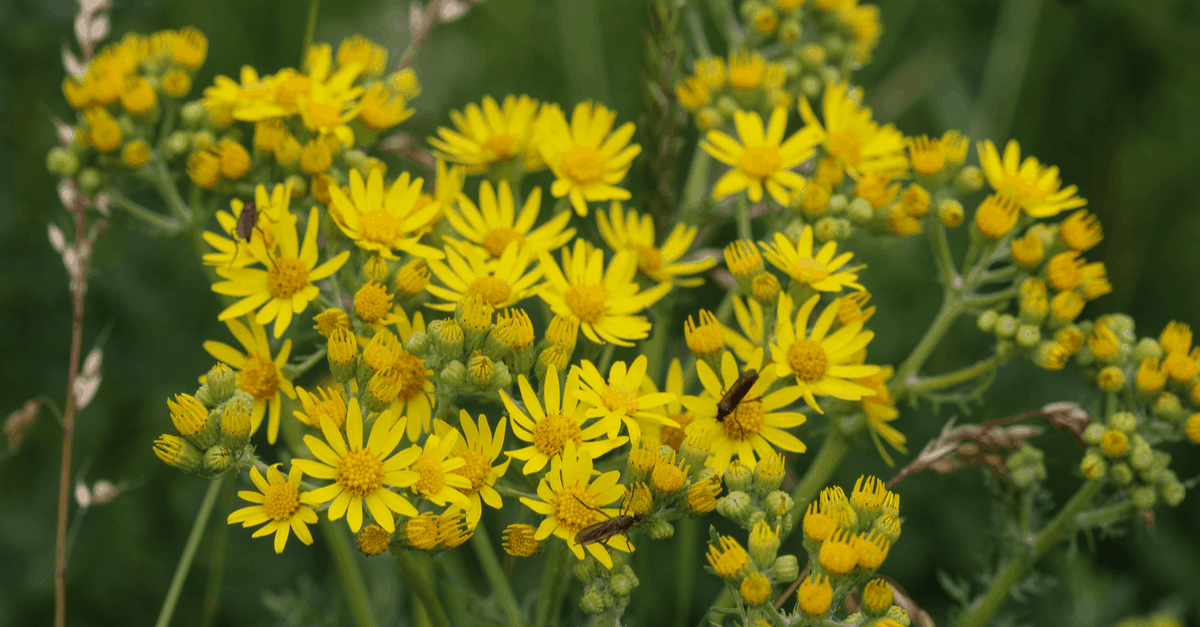
The first leaves contain a short petiole that attaches them to the plant stem. The underside of the leaves may look purple with shallow teeth. The leaves appearing later are directly attached with the stem with deeper lobes. Leaves are arranged alternatively on the stem. Groundsel grows with a shallow taproot and mandatory fibrous roots when it receives full sunlight, and the plant height reaches up to 2 feet tall or more. Groundsel produces smaller and fewer leaves under poor sunlight. Characteristically, the Flowers that emerge are bright yellow, and green brackets surround them with prominent black tips on brackets. Upon maturity, these bracts release white cottony seeds, and the wind carries them to the new locations.
Lifecycle & Growth Pattern
Groundsel has the potential to produce numerous seeds, and an individual plant can produce up to 25000 seeds under favorable conditions. A cottony seed structure allows them to travel a long distance after its dispersion starts in the early spring that could continue till late fall. However, maximum blooming observes during the spring when the plant achieves only 3-4 inches of height. The dispersed seeds don't go dormant and can germinate immediately at the new location provided they get optimum conditions for growth. Generally, 2-3 generations exist within the year, and the generation continuity slows down during the months of extreme summer temperature.
Amazing Facts About Common Groundsel
Common Groundsel-Prevention and Control
Cultural Control
Small populations of Common Groundsel are easily controllable by hand pulling or deep hoeing. Although there is a limited infestation of Common Groundsel in turfgrasses, a mowing exercise close to the soil proves beneficial when practiced well at the start of spring. Nurseries can use organic mulch to stop the growth of Common Groundsel in pots and beds.
Biological Control
Biological methods exist for controlling Common Groundsel using a naturally occurring rust fungus (Puccinia lagenophorae). However, their controlling efficiency remains about 30%. Moreover, its biological control is very much dependent on either or not the Common Groundsel growing habitat supports Rust Fungus presence.
Chemical Control
Control with Pre-Emergent Herbicides
Gallery 75 DF
The Gallery is a specialized herbicide containing 75% Isoxaben that stops Common Groundsel seeds to sprout, and its control may prolong for 8-months. Another drawback of the is chemistry is that the gardeners can use it on only turfgrasses and non-bearing plants. Its residues remain longer in the soil hence not recommended for edibles.

- Isoxaben - 75%
- Gallery herbicide is a specialty pre-emergent herbicide containing the active ingredient
- For use in Commercial Turf-grass, Landscape Ornamentals, Container Grown Ornamentals, Field Grown Ornamentals, Christmas Tree/Conifer Plantations and others * See label for complete list
apply during late summer or early fall for the complete hold-up of seed growth. It will not control already sprouted weeds. But, stop only sprouting them from the seeds. One pack of Gallery is enough for applying over 4000 square meters of turfgrasses in 10 gallons of water.
Control with Post-Emergent Herbicides
Remedy Ultra
It contains 60.45% Triclopyr that controls several broadleaf weeds and grasses, including Common Groundsel. Product application is desired in early spring, and repetition is required in the late spring for knocking down all broadleaf weeds in turfgrasses and the pods containing ornamental plants or vines.
Remedy Ultra absorbs both through leaves and roots and stops further growth on Common Groundsel and weed grasses that soil the beauty of your landscapes and turfgrasses.

- Top rated pasture herbicide
- Low-odor; Works on the entire plant roots and top growth
- Flexible, long-lasting, ideal for pasture restoration, encroaching brush, maintaining fence rows and general brush control
Mix the concentrate in diesel and water as per the recommendation on the product label.
Ortho GroundClear
Ortho Groundclear contains Dicamba, Diquat dibromide, and Flauzifop in these ratios, respectively, (0.67%,2.53%, and 0.84%), which is a tremendous combination to control both narrow and broadleaf weeds during different vegetative growth stages. The chemical absorption is both through leaves and roots, which stop photosynthesis and water uptake immediately. The result is clear and green turf within 2-weeks.

- ORTHO WEED KILLER SPRAY KILLS WEEDS TO THE ROOT: Ortho GroundClear Weed & Grass Killer Super Concentrate1 kills the toughest weeds and grasses to the root, including clover, dandelion, oxalis, chickweed, and crabgrass
- HOW TO USE: To apply this weed killer concentrate for sprayers, mix with water and use a tank sprayer to spray weeds when they're actively growing and the air temperature is above 60°F
- WHERE TO USE: Use this grass and weed killer around perennial landscape plants, trees, shrubs and fences, and on patios, paths, sidewalks, sidewalk cracks, walkways, and driveways
One pack or Ortho Groundclear is sufficient for applying on 200 square meters area. Otherwise, add 5 ounces of concentrate in one gallon of water to cover a 10-12 square meter area.
Primesource Meso 4 SC Select
Primarily, Meso is the same chemistry that you find in Tenacity and contains 40% Mesotrione. This product gives you the liberty to use it during the entire growth stages and cultural practices, which you perform for the vigorously growing turfgrasses. It works both as a Pre-emergent and Post-emergent herbicide and kills several broad and narrow leaf weeds, including Common Groundsel.

- Not For Sale to AZ, OR, WA, NM, MT, ID, WY, NV, AK,HI
- Provides post-emergent control of tough-to-control weeds
- Weeds controlled include crabgrass (pre- and post-emergent), ground ivy, yellow foxtail, yellow nutsedge and dandelion
Add just 1/10th of an ounce in 2 gallons of water and cover 90 square meters targeted area.
Learn How to control and get rid of other weeds in our complete Yard Weeding Guide.