
Binomial Name (Malva neglecta)
Common Mallow belongs to the family of flowering plants, “Malvaceae" which also contains many anticipated plants especially, Bombax cotton, okra, Marshmallow, mallow, and hibiscus. Common Mallow is not acceptable when it grows in turfgrasses, orchards, landscaping sites, and garden beds since it competes for resources that may suppress its growth. It usually germinates in the fall after the turfgrasses receive the first winter rain. It grows everywhere except the snowcapped mountains and desert, whereas a tropical climate is best adaptable for its growth.
Origin and Distribution
Most probably, this edible herb originated from Northern Africa, Asia, and Europe and now exists throughout Asia, Europe, Africa, and North America. Common Mallow predates sunny locations which are arid and moderately fertile. But, grows more vigorously in fertile loams. It can be found growing at sites that usually don't go into regular cultivation. Hence its prevalence in abandoned yards, garden beds, and grassland edges is more common.
Do these features help Identifying Common Mallow?

Common Mallow is a winter annual if it grows in fall, and biennial if it grows throughout the year. The new leaves are smooth, heart-shaped, circular, a petiole that connects them to the plant stem. Each leaf may have 5-7 lobes with a crinkled look. The first true leaves are arranged alternately on the stem. Common Mallow has a spreading growth pattern but, it may sometimes grow 2 feet tall. The plant contains a tap root that goes deeper into the soil. The flowers may be white to bright pink usually, with 5 petals that appear 10 due to thin partition within them. The fruit appears like a small pumpkin with 10-12 sections, each with a single seed.
Lifecycle and Growth Pattern
Since the seed of Common Mallow produces within the chamber-like structure, it can hold only one seed at a time, which is responsible for the continuity of the next generation. Each seed has a tough outer layer that only germinates after it receives handsome moisture. The germination often takes place in the subsequent years when the seed was disbursed. The seed can remain dormant for years, and there is always a fear that could infest any landscape in the coming years. The best germination time starts in the fall in a tropical and subtropical climate that could continue growth depending on the climatic conditions that support its propagation.
Fun Facts About Common Mallow
Common Mallow-Prevention and Control
Cultural Control
Common Mallow young plants are pulled out of the planting soil easily. It's well-supportive when the plant reaches the 4-leaves stage or even before that. Otherwise, its taproot system allows it to germinate again. Additionally, pull out the population before setting seeds. Otherwise, there is always a threat they can germinate in the coming years.
Mechanical Control
Hoeing or rototilling are the best practices that can be carried out twice: once in the late fall and then in early spring. It would considerably reduce plant population and infestations in the coming years. Mowing doesn't support its eradication as they germinate from the roots underlying turfgrass in your lawn.
Chemical Control
Control using Pre-Emergent Herbicide
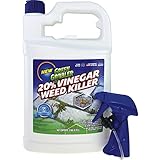
Green Gobbler 20% Vinegar
Research on weed control and observations prove that Glyphosate is not as effective for controlling Common Mallow as it is against other broadleaf herbs. 20% Vinegar is organic and a natural remedy to kill Common Mallow but, keep in mind that Vinegar is a non-selective killer and burns everything that receives its spray mist. Be careful and be selective while spraying near your favorite gardening greens.
Control using Post-Emergent Herbicides
Sedge Ender Weed Control Concentrate
Although the product names after a weed, it doesn't mean that it kills only Sedge. It contains Sulfentrazone and Prodiamine in a ratio of 1.36% & 3.73%, respectively. Both of these active ingredients are good for Pre-emergence and Post-emergence control of several broadleaf herbs and grasses, including Common Mallow, and Sedge. Additionally, the gardeners can give it a try on both cool and warm-season turfgrasses without checking their growth or having any stress that often pre-emergent herbicides do. The mode of action is adsorbing through roots and foliage at the same time along with suppressing the seed to emerge from the soil.
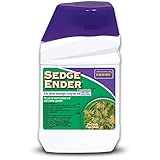
- Sedge Ender Weed Control kills unwanted weeds without killing your lawn; kills yellow nutsedge, crabgrass, goosegrass, foxtail, and other grassy weeds down to their roots
- Use on both warm and cool season grasses for complete coverage; safe for bluegrass, ryegrass, fescue, Bermuda grass and carpet grass
- This product is designed for application before or after weeds have sprouted, it kills the roots and shoots of existing weeds while preventing the growth of newly emerged weed seedlings
One pint of this concentrate can cover between 100-600 square meters of turfgrasses depending on the infestation level using 2-3 gallons of water.
BIOADVANCED 3-in-1, Weed and Feed for Southern Lawns
When it comes to the general health of turfgrasses, they do need proper fertilization to grow vigorously. The turfgrasses need fertilizers that contain more Nitrogen and Potassium. This combination fulfills the nutrients requirement of turfgrasses. Besides, it provides stunning weed control for the ingredients it keeps. Dicamba, Penoxsulam, and Indaziflam in a decent mix of 0.088%, 0.041%, and 0.027%, respectively, brilliantly knock down several broadleaf and grasses that are not desired in your turfgrasses. Nitrogen 35% and Potassium 3% will work on improving the health of turfgrasses.
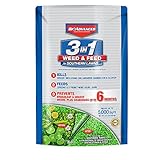
- SOUTHERN LAWNS: Specially formulated for Southern lawns like Bermudagrass, St. Augustinegrass (including Floratam), and more, this grass fertilizer provides care and acts as a weed killer for lawns
- 6-MONTH PROTECTION: Delivers up to 6 months of weed prevention, stopping listed broadleaf and grassy weeds, including crabgrass
- WEED KILLER: Kills listed weeds like dandelion, dollarweed, and clover, serving as a reliable weed and feed for lawns to keep your lawn healthy and maintain its beauty
One 1-pounds pack can effectively cover a turfgrass area up to 500 square meters. Try to avoid northern grasses and do check the temperature if it falls between 50-90 Fahrenheit, it's an ideal time for applications.
Season Long Weed Control
This concentration offers doubly control at the same time. It kills the weeds that germinate in the turfgrass and stops the rest from emerging, including Common Mallow and several other broadleaf weeds.
The active ingredients in the range of (Isoxaben) 2.63%, (2,4-D) 4.73%, (Mecoprop-p) 1.10%, and (Dicamba) 0.52% with Potassium salt prove fatal for all types of weeds when applied under the guidance from the product label.

- 6 MONTH WEED CONTROL: Kills existing lawn weeds and prevents listed weeds from emerging, enjoy up to 6 months of protection with our 2-in-1 formula
- HELPFUL WEED KILLER: Kill over 200 listed weeds including dandelions and clover with our lawn weed killer
- RAPID RAINPROOF FORMULA: Rainproof protection in one hour after application
One 29 ounces’ product bottle can provide effective control over 800 square meters of turfgrasses.
Learn How to control and get rid of other weeds in our complete Yard Weeding Guide.