
Binomial Name: (Euphorbia maculata)
Prostrate Spurge is a summer annual broadleaf herb belonging to the family ”Euphorbiaceae” and the Genus “Euphorbia" and often found in nutrient-deficient soils besides the turfgrasses that are poorly maintained or their soil has compacted due to non-cultivation. Its ability to launch and nurture in various climate and soil conditions and its low mowing height makes it a strong competitor of turfgrasses throughout the US. However, Prostrate Spurge is not a competitor of the cropped lands. Airborne digital imagery shows its existence up to 8200 feet above sea level. Whereas its population decrease with an increase in elevation. Prostrate Spurge is a species of exposed soil and grows on even sandy soils. It grows beside roadsides, gardens, walkways, and landscapes throughout the US.
Origin and Distribution
Prostrate Spurge is a native to the eastern United States, and now, it grows more vigorously in California than any other member of the same family. Indiana, Maine, New Hampshire, Massachusetts, Rhode Island, Connecticut, New York, New Jersey, Delaware, Maryland, Virginia, North Carolina, South Carolina, Georgia, and Florida except for Alaska, are considered a hub where Prostrate Spurge grows besides six other spurges. Prostrate Spurge has also been deliberately introduced to British Columbia, Nova Scotia Ontario, New Brunswick, Quebec, and Prince Edwards Island. Primarily, All the Spurges need the same management technology and measures due to their similar growth pattern and spreading behavior.
Prostrate Spurge-Identification
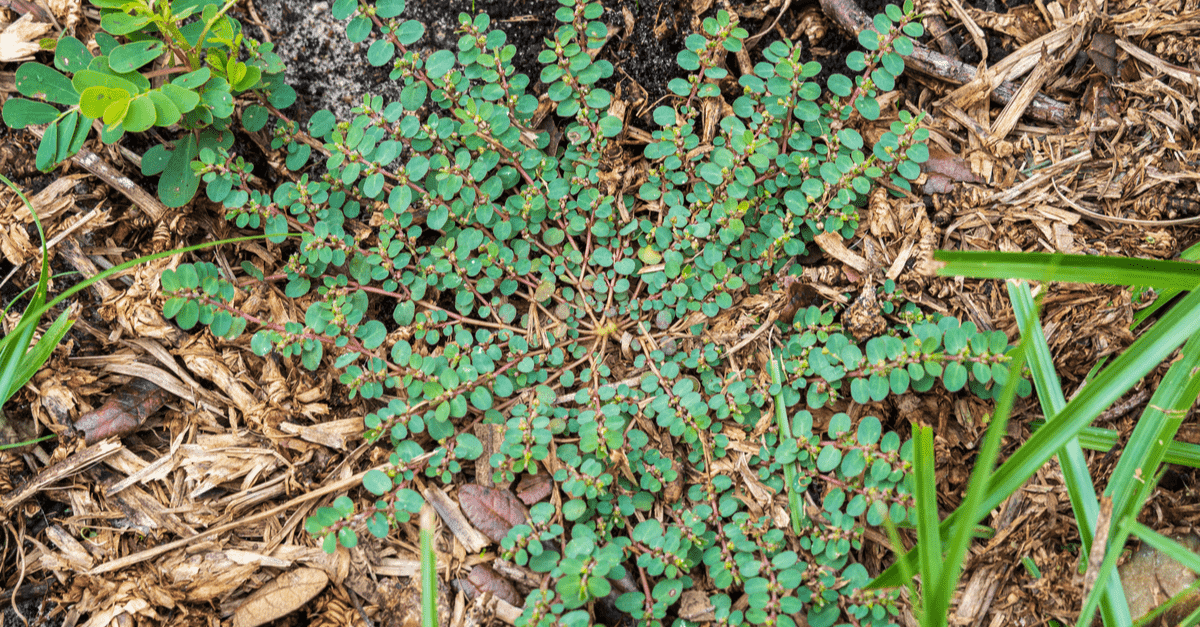
Prostrate Spurge holds close to the growing location forming dominant spreading mats of up to 16 inches not more than ½ of an inch's height. The leaves are arranged oppositely on a hairy, slender stem. The leaves are 1/6th of an inch in length and 1/10th of an inch in width. Often, the leaves contain a red spot on the upper surface, and for this reason, Prostrate Spurge is called Sandmat Spurge as well. The branching pattern is alternate in Prostrate Spurge, and their terminal ends hold both male and female flowers. Usually, one pistillate flower is surrounded by several staminate flowers. The same female flower develops into a three-lobed capsule having a hairy skin.
Prostrate Spurge-Propagation and Lifecycle
Since Prostrate Spurges is a summer annual, it produces several thousand seeds that are tiny and remain dormant until the favorable conditions arrive. The seed germination often takes place in the summer from the freshly dispersed seeds. Otherwise, the seeds produce in the winter go dormant till the spring. The temperature range for seed germination lies between 60° to 100°F. Otherwise, the optimum temperatures that support maximum germination are between 75° to 85°F. When there is sufficient moisture in spring, they start germination that continues till early autumn. Once the germination completes, leaves rosette appears that start spreading on the surface developing dense mats. If the conditions allow vigorous vegetative growth, seed production takes place in 5 weeks only.
Fun Facts About Prostrate Spurge
Prostrate Spurge-Prevention and Control
Cultural Control
Since Prostrate Spurge needs plenty of sunlight, better turf management could leave the herb trailing under the shade formed by dense turfgrasses. It is only possible if the turfgrasses are adequately watered and fertilized at the start of spring. Also, practice repeated mowing as it will not allow Prostrate Spurge to mature and set seeds. Never delay mowing the turfgrasses later than 3-weeks if there's fear of Prostrate Spurge infestations. Additionally, a vigorously growing turf would not allow any sort of weed growth. A small population may be hand-pulled but, larger areas need surface softening that suppresses Prostrate Spurge seed germination and stops making mats in the turfgrasses.
Chemical Control
Control using Pre-Emergent Herbicide
Barricade Professional-Grade Granular Pre-Emergent Weed Control
A pre-emergent herbicide like Barricade is an intelligent decision for Prostrate Spurge prevention. Barricade contains 0.48% of Prodiamine which, stops the seed from germination. It comes in a granular form and needs a spreader to broadcast them in your turfgrasses. Apply Barricade in pre-germinated turfgrasses when the surface temperature is around 55°F as their germination may start at 60°F. The best application times are early spring and early autumn.

- Designed to prevent weeds; will not aid in eliminating existing weeds. Prevents grassy and broadleaf weeds, including crabgrass, poa annua, goosegrass, henbit, and more.
- Contains 0.48% of the active ingredient prodiamine for professional-grade weed control for early spring and fall applications
- Made with patented DG Technology (dispersible granule) ensures granules dissolve rapidly upon watering, moving weed control directly into the soil for maximum impact
Don't forget to water your lawn once you apply Barricade. 18-pounds of the product size is for broadcasting in between 5800 to 6000 square feet area. Barricade is a professional and specialty herbicide. The gardeners may ask a professional applicator for assistance.
Control using Post-Emergent Herbicides
Monterey Spurge Power
Spurge Power combines 3-herbicides with a different mode of action to prevent and control Prostrate Spurge. MCPA (56.14%) burns the foliage within 3 to 4 days, and the Spurge stops nutrients uptake. Triclopyr (5%), on the other hand, stops the seed germination in the turfgrasses, and Dicamba (3.60%) creates a hormonal imbalance in Prostrate Spurge and other broadleaf weeds, causing their death. This combination is a standalone formulation that kills even the toughest broadleaf weeds in the turfgrasses without exerting suppressive effects.

- EFFECTIVE BROADLEAF WEED CONTROL - Effective broadleaf weed control for hard to control weeds.
- CONTROL - Spurge Power contains 3 active ingredients that control Spurge, Dandelion, Oxalis, Creeping Charlie, Clover, Wild Violet, and other broadleaf weeds in lawn areas.
- FOR WARM AND COOL SEASON LAWNS - May be used on both warm and cool season lawns such as bluegrass, fescue, ryegrass, bentgrass, bahiagrass, bermuda grass, and zoysia.
An optimum product dose remains about 1.0 ounces in 1 gallon of water. Exceeding the product dose beyond 1.5 ounces per gallon of water could potentially harm turfgrasses.
Weed-Free Zone
Weed-Free Zone combines 4-ingredients instead of three, and every ingredient has a broad spectrum against a variety of broadleaf herbs including, Prostrate Spurge. It contains 2,4-D, Mecoprop-p, Dicamba, and Carfentrazone in 10.49, 2.66, 0.67, and 0.54%, respectively. No one can find a better broadleaf hunter than Weed-Free Zone since the chemistry and ingredients percentage are promising with a proven track record against Prostrate Spurge. Additionally, the combination is ideal for most cool-season and warm-season turfgrasses. Moreover, its label prescribes variable doses for turfgrasses. Better consult the product label which, is quite informative if you don't need help from someone else.

- Controls over 80 broadleaf weeds including Clover, Spurge, Chickweed, Thistle, see label for more.
- Safe on Kentucky Bluegrass, Bermudagrass, Bahiagrass, Zoysiagrass and more. See label for full list.
- The rapid and effective weed killer provides evidence of injury within hours of application.
usual product dose varies between 1 to 1.5 ounces in 1 gallon of water for 1000 square feet of Prostrate Spurge or broadleaf weeds affected area.
Learn How to control and get rid of other weeds in our complete Yard Weeding Guide.