
A screw gauge is an essential tool for a mechanical engineering student; I know this because I used to be a school teacher.
Last week, my younger son came to seek my assistance. Being a mechanical engineering student, he has to deal with a lot of projects that involve using a screw gauge. But since he is pretty new to the field, he didn’t know how to use it.
So, I took it upon myself to teach him how to use a screw gauge so that he gets an A+ in his projects. Not to sing my own praises, but I used to be one of the best mechanical engineering students at the University of Texas, Austin, back in the 90s.
Even though I have developed a keen interest in gardening over the years, engineering will always have a soft corner in my heart. Hi! This is Stacy Smith, and in this article I will be telling you how to use a screw gauge.
Now, without wasting any more time, let’s get straight to the good stuff!
What Are The Various Screw Gauge Parts?
Back in my university days, a screw gauge was my go-to tool for measuring wire diameters and thickness of papers. Apart from being cheaper than an electron microscope, it provides accurate results, which is why it is a popular tool among engineering students.
Before explaining the purpose of a screw gauge, I will tell you about the different parts so that you can understand how it actually works.
1. Ratchet
Let’s start with the ratchet; it is nothing but a built-in safety device in the screw gauge. It works as a limiting device by restricting the spindle from moving too much when you are adjusting it, thereby preventing damage.
2. Screw
The screw lets you measure very small lengths and distances. There is a part called a thimble at the end of the cylindrical tube, which consists of the Vernier and secondary scales. You can rotate the thimble to adjust and move the spindle to accurately measure objects.
3. Barrel
The barrel is the cylindrical tube that you see connected to the frame; it is also known as the sleeve. You will find a small scale which reads the length of the piece that you are measuring. Also, note that this part of the micrometer is stationery.
4. Frame
Another important feature is the frame, the U-shaped metal piece you see in every screw gauge. It consists of two studs that clamp tightly onto the object which you are measuring.
The larger stud is known as the spindle, and the smallest stud is known as the anvil. A closer inspection reveals that the spindle rotates, whereas the anvil is fixed.
How To Use A Screw Gauge
I hope by now you have a clear understanding of the different parts of the screw gauge. In this section, I will be teaching you how to measure objects using a screw gauge with the help of a wire.
So, let’s get started!
- Before measuring, ensure that you smoothen the wire
- Clamp the wire using the frame, and then tighten the grip by moving the spindle
- Once the wire is tightly clamped, start taking the readings
Main Reading
You will get two types of readings - main reading and a Vernier reading. First, let me tell you about the main reading, which you will get from the main scale.
Before taking the reading into account, ensure that you know the length per division of the scale because it differs from one screw gauge to another. Now, to figure out the length per division, you need to check the number of graduations or lines present.
In most cases, it is usually one, following which you need to divide the length by the number of graduations. Once done, the last graduation that shows up on the main scale in millimeters is the main reading.
Secondary/Vernier Reading
The secondary reading, also known as the Vernier reading, is taken from the thimble, which features a rotating Vernier scale. In this case, the number of divisions is displayed on the scale instead of the length.
So, in order to find out the length in millimeters, just divide the number of divisions by 100. Now, to find out the Vernier reading, you need to locate the point where the lines of the rotating scale and the lines of the main scale coincide.
The number that you get on the coinciding point on the rotating scale is the division. Similarly, follow the calculation mentioned above to get the secondary reading but in rare cases, when the lines don’t coincide you can consider the nearest division.
Also, note that the length of the object is the sum of the secondary and main readings.

- Quickly and accurately determine the screws size
- Recommends the drill bit or tap size needed for the screw
- Standard & Metric
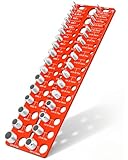
- Precision Thread Checker Tool: Our nut and bolt thread checker quickly identifies 30 different sizes of bolts and nuts, perfectly measures from M2 x 0.4 to M14 x 2.0 metric threads and #2 - 56 to 5/8 - 18 standard threads, your ultimate sae & metric thread gauge for automotive, and machinery maintenance
- Pro-Grade SAE/Metric Thread Identifier: The bolt and nut identifier gauge is made of CNC-machined anodized aluminum alloy and premium steel bolts. All bolts and threads meet Go & No Go Class 2B ANSI gauging standards, ensuring maximum thread strength and precision accuracy for both standard and metric nuts, sturdy and durable
- Easy-to-read Bolt Size Finder: The bolt identifier board is designed with white lettering on a red background and durable laser-etched inch and centimetre scales on the edges of the bolt sizes and thread gauges for clear and easy reading, making identification of a wide range of thread sizes quick, accurate and easy
Why Should You Use A Screw Gauge
Here are a few reasons why you should use a screw gauge.
1. Value For Money
Firstly, it comes with an affordable price tag, which ensures that it delivers value for money. Hence, it is an ideal option for engineering and science students
2. Durable
Screw gauges are robust, which makes them durable and long-lasting.
3. Versatile
One of the best parts about screw gauges is that they are versatile, meaning they can serve a wide variety of applications.
4. Highly Accurate
The main benefit of using a screw gauge is that it is highly accurate and can measure small lengths with optimal precision. Plus, it is easy to use, which is a bonus.
Conclusion
So, that was it and I hope that you enjoyed reading my guide. I am sure that now you can confidently use a screw gauge.
In case you face problems, feel free to refer to this article. Before wrapping up, I would suggest one last thing: keep your screw gauge in a safe place, away from children, to avoid accidents.
On that note, it’s now time for me to water my plants. Hope to see you soon!