
Are you a plant lover with the noob skills of a budding gardener?
I am happy to tell you that you got at least one thing right, which is deciding to start with an Aloe plant. In my opinion, succulents are the best type of plants to begin your gardening journey with.
But you can’t take them for granted because however low maintenance they are, the leaves will turn brown if not looked after properly. During my university years, I used to keep aloes in my dorm room in an attempt to perk up the otherwise morbid place.
And that’s when I mastered the skill of keeping aloe plants alive. However, I did kill them in every way possible before learning how not to. But that’s alright; making mistakes is important for growing in life, right?
Hello guys, it’s me, Stacy Smith, and I am back with yet another gardening guide. If you’ve been wondering, “why is my aloe plant turning brown? What am I doing wrong?” then you might find this one helpful.
So, let’s get started right away!
Why Does Aloe Plant Turn Brown?
Several factors can be responsible for the wilting or browning of aloe plants. Let’s have a look at some major reasons:
1. Due To Overwatering Or Too Much Moisture
Although water is an essential requirement for plants to survive, it is easy to go overboard in an attempt to keep them healthy. Avoid doing that! Understand that simply watering a leafy plant isn’t enough - you need to find a balance.
The first signs of overwatering in aloe can be spotted in the fleshy leaves. If you can see soggy or wet spots on the leaves, you might have a watering issue. Eventually, the patches will spread to the entire structure, and the leaves will turn soggy and ultimately go brown.
In addition to that, excessive watering can lead to poisoning or rotting in the roots. And once roots are affected, it becomes extremely difficult to save the plant. Therefore, my advice is don’t take leaf browning lightly and start looking for a solution the moment you spot it.
2. Due To Underwatering
Aloes are succulents, and to be honest, they are fantastic for beginners or lazy plant enthusiasts because they don’t need much care. They are naturally adapted to semi-arid conditions and therefore require less water to thrive.
But if you notice brown tips on your aloe, then chances are it needs more water. If this goes on for too long, the otherwise hydrated, thick, and fleshy leaves will start appearing hard and stiff. The brown tips will also spread along the length of the rest of the leaves.
3. Due To Excessive Heat Or Sunburn
Succulents, being immune to semi-arid conditions, can tolerate a lot of heat and they do not get sunburnt easily. However, a combination of direct sunlight and low watering in very dry air can burn your aloe and brown its leaves.
The temperature range of 55 to 80 degrees Fahrenheit is best-suited for aloe plants, so make sure that you pay attention to this factor. A temperature beyond 80 degrees is bound to affect your plant negatively.
4. Due To Dry Soil
Along with water, good quality soil is immensely important for the growth of plants, and people often tend to overlook that. I’ve been gardening for decades now, and trust me when I say, “been there, done that.”
But, the question is, how to know if your soil is dry? Well, one obvious sign is the appearance of cracks on the surface. Additionally, your pots need to be properly aerated with breathing holes at the bottom. If your soil isn’t able to breathe, the air exchange isn’t happening properly, which will lead to the browning of the leaves.
How To Stop Your Aloe From Turning Brown?
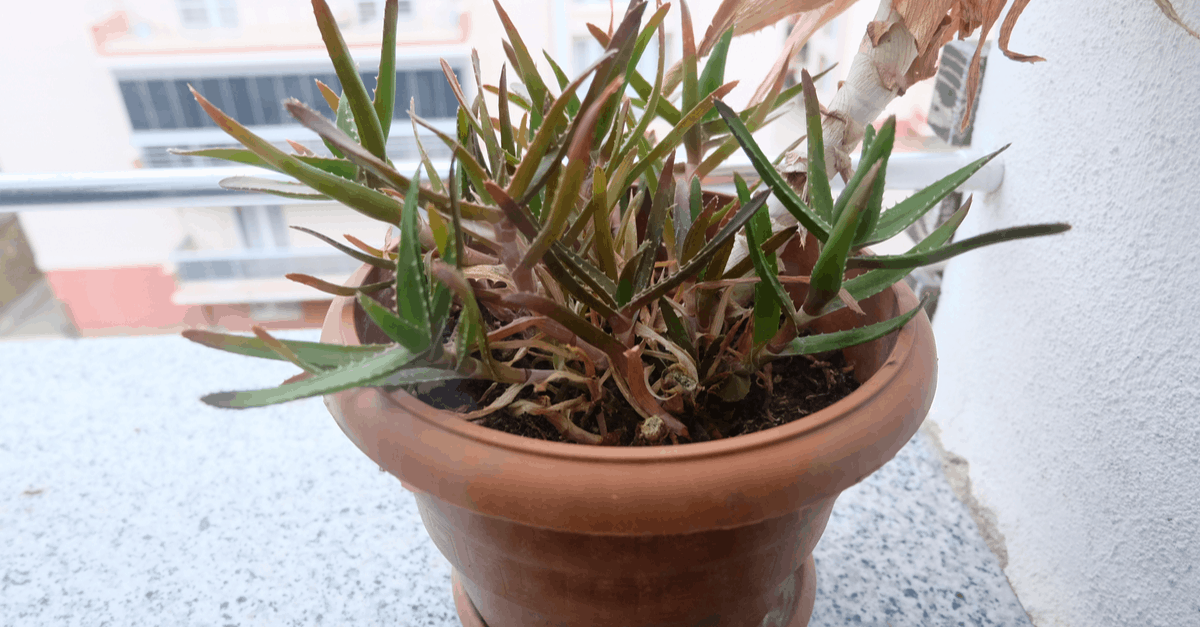
Now that I’ve discussed the plausible reasons for the problem, I’ll move on to providing solutions. By the way, were you able to find the culprit for the browning of your aloe leaves? Do let me know in the comments!
1. Find The Water Balance
As I said before, watering plants is indeed quite tricky. Water them too much, and they’ll overhydrate to death, hold it back a little, and they’ll shrivel out of dryness. Plants can be dramatic at times, don’t you agree? Just kidding!
It is essential to strike that balance while watering your aloe. It’s going to sound absurd, but aloes need to be watered only once a week, depending on the weather. If you’ve been exceeding that limit, you’re doing it wrong.
If you’re not too sure about leaving your aloe unwatered for a week, don’t hesitate to do the touch test. Hold the leaf and firmly press your fingers on the surface. Is it fluid enough, or does it seem rigid? If the leaves seem stiff, water the plant right away.
2. Repot Your Plant
If the brown leaves aren’t going away no matter how much you experiment with watering, then poor soil quality might be the reason. You’ll need to uproot your aloe and replant it with fresh and nutritious soil in a new pot.
Make sure that the new pot has enough holes to let the water percolate out and maintain a healthy exchange of air.
Final Words
Aloe plants are just the best and are one of my absolute favorites. They don’t need much sunlight because of which they are perfect desk plants. Plus, I like adding a green touch to my workspace; it breathes life into the place, and I recommend you try it out!
That’s about it for this guide, folks. If your aloe plant has been turning brown, it might be because of the four major reasons I covered today. I hope you’ll find my insights and solutions helpful.
Well, it’s time for me to sign off! I’ll see you next time. Take care!