
Scientific Name: (Thrips tabaci)
Thrips belong to the family Thripidae under the order Thysanoptera. They are tiny and slim and suck sap from the outer layer of new leaves from the undersides, tender shoots, and flowers, causing stippling on the upper surface of the leaves besides silvering the lower surface of the leaves. The stippling of the leaves leads to discoloration, starting from the yellowing of the leaves and defoliation, ultimately. Thrips are also responsible for many disease vectors when their infestations are high. Some thrips species are harmless for the host plants, while others may be pests in a garden. They can spread to the new locations using several carriers such as wind, water, and the infested material brought from the nurseries.
Origin and Distribution
Thripidae is the species-rich family that contains over 290 genera and more than 2000 species and tabaci is also one of them. They are also called onion thrips and are considered to have originated in the Mediterranean region, which is now present throughout the world except for Antarctica. They are the major pest of cotton, garlic, leek, onion, cabbage, broccoli, asparagus, cauliflower, melons, cucumbers, tobacco, potato, strawberry, and many orchard and ornamentals through all states of the US. Thrips tabaci is also thought to have an association with the spreading of the tomato spotted wilt virus and, it was identified in 1927.
Thrips- Identification
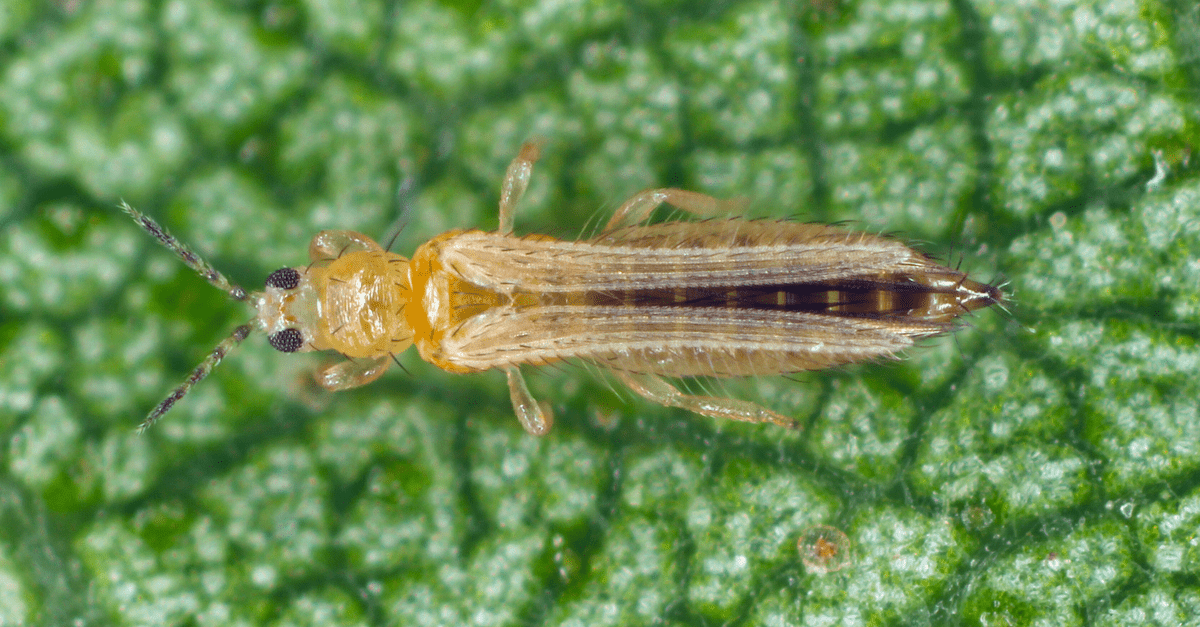
Bodies of most of the adults are slender and elongate measuring less than 1/20th of an inch, and they bear long threads on the edges of both pairs of long and narrow wings. Larvae are slender or elliptical and without wings. Their color ranges from semi-transparent to white, yellow to brown, and black depending on the species, host specificity, and the environment where they live. More than 6000 species have been reported so far in different regions of the world. The complete identification of thrips species reveals that some species are harmless to the plants if they are not on a specific host. Greenhouse and Avocado thrips often puncture avocado skin whereas, Citrus thrips beside their presence on avocado, don’t harm them. A foliage feeding thrips lay the egg on the leaves, buds, and flowers which are either elongated, cylindrical, or kidney-shaped.
Thrips- Lifecycle
Thrips may have about 8-generations in a year depending on the temperature, and the complete life cycle could only be 14-days under warm conditions. After hatching, thrips pass through 4 reproductive stages, to which two remain non-feeding: the prepupal and pupal. Otherwise, the larva feeds during the first and second instar and stops feeding before pupation. Usually, a female lays elongated, cylindrical, or kidney-shaped eggs on the plant surfaces where larvae feed later. Pupation takes place in the tree cracks or on the soil surface whereas, the greenhouse thrips pupate on the lower surfaces of the leaves. Thrips may complete the entire lifecycle in 10-day provided the conditions remain ideal for all growth stages.
Symptoms and Types of Damages
Often, thrips feeding is more damaging during the initial stages of crop growth on new leaves and tender shoots. Their damages are severer when the conditions are dry and hot. When fruits and vegetables have injured, their shape becomes ugly, and market perception reduces. However, thrips don't pose a serious threat to developed trees but, they are harmful when attacking the seasonal crops, fruits, and vegetables. Usually, thrips infestations stunt plants' growth. Initially, the stippling appears on the upper surfaces of the leaves, and they become yellow and distorted and drop from the branches prematurely. Tender shoots and terminals change the appearance and curl backward. Similarly, the petals when highly infested, become distorted, discolored, and rolled.
Where do the Thrips come from?
Adult thrips feed on the lower surfaces of the leaves, pollens, and buds. There are also sites where females lay their eggs. Most eggs drop to the soil surface or disappear after going into the crevices and cracks in the bark. The eggs that had fallen on the surfaces of the soil overwinter under plant debris and ground covers. These are also the potential sites for hatching eggs, and they have appeared after the conditions become ideal for eggs hatching and continue feeding on desired stuff. Otherwise, a hot and dry climate is the appearance of the garden. Look for their presence in your garden when the temperature ranges between 68-98°F.
How to Prevent Thrips?
Besides following all preventive measures if, thrips infestations go beyond your control, here are the most authentic ways to keep their population suppressed using the biological, organic, and chemical methodologies;
Thrips- Control
Biological Control
NaturesGoodGuys -Amblyseius cucumeris
Amblyseius cucumeris is an aggressive predatory mite that feeds on the immature stages of many thrips species including, thrips tabaci, chill thrips, melon thrips, and whiteflies beside, several mites. It is highly effective for controlling the thrips species that damage the foliage during the initial stages of their growth. Usually, slow-release hanging sachets are available that contain the food source for up to 4-weeks. These mites emerge from the sachets that could hang with the tree branches away from the direct sunlight. Amblyseius cucumeris perform the best under a temperature ranging from 43 to 90 °F and a relative humidity level between 65-75%.
No products found.
Usually, 1-sachet is good for 3 feet or one plant. Otherwise, 5-10 adult mites per square foot of garden area.
Nature's Good Guys-1,000 Orius insidiosis - Minute Pirate Bugs
Orius insidiosis are also called Minute Pirate Bugs, which are specialized bugs for killing the thrips that are on the flower. A female lays eggs just near sites that thrips have occupied during the infestation. A female lays eggs that hatch in around 3-weeks and starts feeding on thrips immediately. If the conditions remain conducive for their reproduction, they could reveal many generations in one cropping season. Both nymphs and adults are adept in preying on all stages of thrips. Usually, they insert their long beak into the victim’s body and suck body juice leaving only a skeleton behind. They are avid eaters and target only an infested flower.
No products found.
One live Minute Pirate bug can eat up to 80 live larvae in a day.
Organic Control
Bonide- Captain Jack's Dead Bug Brew
The active ingredient of Captain Jack's Dead Bug Brew is a soil-dwelling bacteria Spinosad, and this formulation contains both Spinosad A, D in its ready-to-use product. The active ingredient remains only 0.001% since the gardeners don't need to mix it before spraying on the foliage of the plants. It is OMRI listed and allowed for use in organic gardening worldwide. Anyhow, it is fast and works seamlessly to control the listed pests, including thrips during the larva stage. The best to apply remains early to late spring.
No products found.
The already installed nozzle makes it easy to spray the foliage of the plants.
Safer- Neem Oil Concentrate
It contains 70% of clarified hydrophobic extract of Neem oil that derives from the seeds. Neem extracts can replace horticultural oils and can be used as a dormant or delayed spray. They are a broad spectrum and control insects, mites, and funguses besides having ovicidal action. Neem Extracts are safe, OMRI listed and recommended in organic gardening for indoor and outdoor cultures. Apply in early spring when the temperature is around 43°F.
No products found.
Add 1 ounce of product concentrate in one gallon of water and target egg-laying sites in early spring. Repeat after two weeks if necessary.
Chemical Control
Acephate 97UP 1lb bag
Acephate is generic Orthene with 97% technical (active ingredient). It's a systemic insecticide and smells like rotten eggs. Use facemask, gloves, and goggles while applying since its drift can make you sick. However, it works well against aphids, thrips, borers, and whiteflies during early instars. Acephate is never recommended for indoor use and on the edible due to the high risk of prolonged residual effects. Read the product label before buying any systemic product.
No products found.
Add between 5 to 7 grams per gallon of water and never exceed product dose as it kills bees, predatory insects, and pollinators and can pollute water reservoirs.
Check out our other guides on common garden bugs.