
Scientific Names: (Manduca quinquemaculata)
The tomato hornworm is a caterpillar and common garden pest that belongs to the family Sphingidae in Manduca genera. The tomato hornworm is also referred to as the Five-spotted hawkmoth. The tomato hornworm feeds on plants in the Solanaceae family including, tomato, peppers, eggplant, and potato besides garden plants. The adult form of the tomato hornworm is a relatively large and robust-bodied moth. The adult moth feeds on the nectar of various flowers and remains most active from dusk until dawn. Tomato Hornworms can be shocking to behold when you finally notice them. Tomato Hornworms merge into the foliage of your plants that may take some time before the gardeners become able to pinpoint the cause of destruction to their precious tomato plants. Tomato hornworms are the most destructive in their caterpillar stage.
Origin and Distribution
Tomato Hornworms are native to North America and Australia. The tomato hornworm is widely distributed in North America and can be found from northern Mexico to the southernmost region of Canada, though it is not uniformly throughout this range. The tomato hornworm is less frequent in the Southeast, where it replaces tobacco hornworms in the region. In Florida, hornworm damage on tomatoes is typically caused by the tobacco hornworm, rather than the tomato hornworm, despite its common name. The tomato hornworm also maintains a good population in Northern areas such as British Columbia, Nova Scotia, Ontario, Quebec, Arizona, Californian, Florida, Georgia, Hawaii, New York, Texas, Virginia, Utah, South Carolina, Ohio, Missouri, Oklahoma, and Maryland on commercial and garden plants in the family Solanaceae.
Tomato Hornworm – Identification
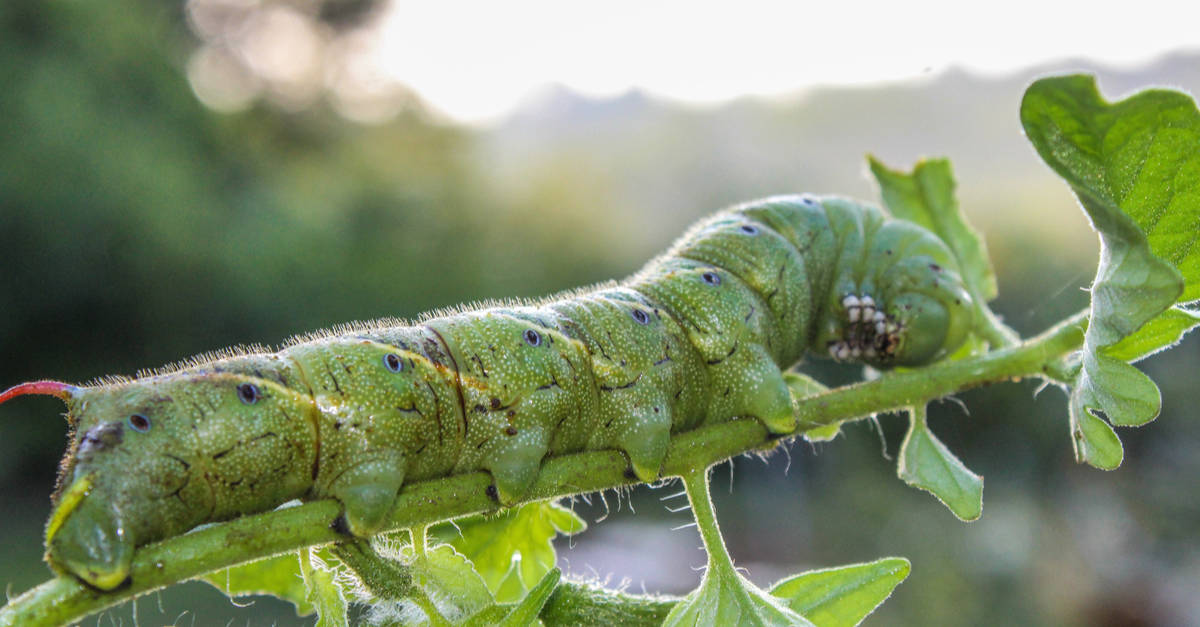
Tomato hornworms are known for their large size. A single caterpillar can be up to 5” in length! This means you can surprisingly see a giant green caterpillar crawling across your tomatoes foliage. The caterpillar is green or yellow, sometimes pale, and has a sharp horn coming out of its rear end. They also have noticeable ‘V’ like patterns that go down their bodies. These markings are distinctive yellow, while most of the body is green. Their head possesses visible eyes and many tiny white spots throughout the body. The strips are accompanied by a pair of spots on both sides, which are usually orange or tan. Moreover, Tomato hornworms are technically the larval form of adult moths.
Tomato Hornworm – Lifecycle
The tomato hornworm has a long life cycle compared to other pests of similar nature. The process starts with an adult moth laying eggs on the undersides of leaves. This moth is large with brown, black, silver, and other dark-tone patterns. The moths will lay eggs in late spring, which are green-white and often hidden under the leaves. The eggs hatch in a week, feeding continues for up to six weeks before developing a cocoon for overwriting in the soil. They'll fall off the host plant, dig the soil and begin pupating into a cocoon. There are usually two generations of tomato hornworms per year, with this cycle repeating itself. The moths lay their eggs on the underbellies of leaves in the late spring. The moths emerge the following spring to continue the cycle, laying a fresh round of eggs on the garden plants. In warmer climates, there can be multiple generations of tomato hornworms each year.
Symptom and Types of Damages
Damage to crops or garden plants is caused by the larval stage of the tomato hornworm. As they mature, hornworm caterpillars feed continuously on their host plants, not moving far from the egg deposition sites. Other than seeing the actual hornworm eating your plant, there are other telltale signs that your plants have a hornworm problem. These damages may be spotty or chewed leaves, brown foliage, and damaged or eaten crops. The eggs may be visible on the undersides of the leaves. The adult moths may be hovering around the plant with significant damage to foliage, flowers, buds, and tender shoots that result in severe defoliation or deformed fruit.
Where Does the Hornworm Come from?
In the garden, they emerge from the eggs deposited on the undersides of the leaves when the garden temperature becomes conducive for their reproduction. Whenever your garden temperature exceeds 65°F, look for them in the top foliage. Otherwise, 82°F would trigger their infestation and they could go out of control.
How to prevent Tomato Hornworm?
Besides following all preventive measures if, Tomato hornworm infestation goes beyond your control, here are the most authentic ways to suppress their population using the biological, organic, and chemical methodologies;
Hornworm – Control
Biological Control
Good Bugs - Ladybugs
Ladybird beetles are well-acknowledged predatory bugs that feed on many aphids, mites, scale insects, and larvae and eggs of several other slow-moving insects. About 450 strains of ladybugs are native to North America, while hardly a few of them are pests besides some benefits introduced from other countries. Beneficial species feed on both adults and eggs of tomato hornworms, provided the aphids are already scarce in the field. Otherwise, they could feed on aphids first and move to the target insects. Whenever live bugs are released in the garden, ladybirds lay eggs on the surfaces of the leaves. The eggs hatch and, the beetle larva become ready to feed on young larvae of the crawlers within 7-days.
No products found.
About 1500-live bugs can effectively control tomato hornworms in 1000 square feet of garden area.
Green Lacewing- 1000 Eggs
Green Lacewing is another class of predatory insects that goes after the crawlers and slow-moving insects. Green Lacewing is Chrysoperla rufilabris which is red-lipped lacewing and it remains near the site where it was released. Lacewing feeds on the eggs, larvae, and caterpillars of tomato hornworms if applied at the start of the spring. Spring-releasing can't allow tomato hornworms to establish if their reproduction conditions remain ideal in your garden. Green Lacewing is also friendly with Trichogramma, Praying Mantis, and Ladybugs, and together they could offer you a pest-free garden in all respects. About 1000-Green Lacewing is enough for 2500 square feet of garden area.

- 1000 Live Green Lacewing Egg
- Wait to release Lacewing Eggs until you see larvae moving inside package.
- Each green lacewing larvae can consume up to 600 aphids in their larvae stage!
Green Lacewing eggs hatch in about 5-days, and that is the best time to release them, preferably early spring.
Organic Control
Bonide - Captain Jack's Dead Bug
Captain Jack’s Dead Bug contains Spinosad that possesses a unique mode of action for killing many species of pests including, tomato and tobacco hornworms. The Spinosad alters the role of GABA and nicotinic channels that trigger rapid muscle contraction that leads to insects’ paralysis and death finally. The product derives from a bacteria, Saccharopolyspora Spinosa, that exists naturally. Captain Jack's Dead Bug is OMRI listed product and recommended in organic gardening worldwide.

Add 2 ounces of the product per gallon of water and apply to the foliage of the plants using a mist sprayer against tomato and tobacco hornworms.
Monterey- Bacillus Thuringiensis, Caterpillar Killer Insecticide Concentrate
Monterrey Caterpillars' concentrate is 98.35% of viable spores of Bacillus thuringiensis Kurstaki strain and each milligram consists of almost 6-million active spores that produce Cry proteins. Cry proteins are toxic for the mid-gut of foliage feeding larvae of many insect species including, tomato hornworms. These proteins adhere to the mid-gut of tomato hornworms and become the cause the death. BT is a gram-positive, soil-living bacterium that occurs naturally on many types of plant surfaces, and the bodies of decaying insects. It also parasitizes both tomato and tobacco hornworms. Bacillus thuringiensis is also used in the making of GMO crops such as BT cotton, and BT corn that contains the cry protein. Monterey BT is OMRI listed and can be applied to the foliage of edible plants, including vegetables, fruits, and flowers.

Mix 4-teaspoons of Monterey BT concentrate per gallon of water and apply thoroughly on the foliage of the plants.
Chemical Control
FMC- Talstar Pro
Talstar- Professional contains 7.9% Bifenthrin, a systemic and residual insecticide, which is pretty good at controlling tomato and tobacco hornworm eggs, larvae, and adults that feed on the foliage of the plants. However, Bifenthrin residues can stay up to 90 days in the environment and the soil and are not permitted to spray on foliage of edible plants throughout the US. Only one drenching application could kill the adults within 24 to 72 hours, even if the surface temperatures are high.
No products found.
Bifenthrin is a highly concentrated product, and only 5-6 ml is mixed per gallon of water for applying on non-edible plants. Otherwise add 10 ml per gallon of water for soil drenching. Read the product label carefully and follow the listed instructions.
Check out our other guides on common garden bugs.