
Most homeowners think that tree pruners are for professionals, but that’s only until they become gardeners!
Be it for grooming or health purposes; there’s no denying that pruning is a crucial part of the plant development process. And with the right tool and technique, you don’t have to rely on professional services every time your trees need a trim.
Having spent so much time looking after my garden, I learned that not every pruner will fit all your needs. As your plants grow, so will their pruning needs, and that will likely require you to have different pruning tools.
Sure, there are many options in the market, but choosing the right one is fairly simple, provided you know how to use them. That’s why when my friend approached me to help her pick a pruner, I seized the opportunity to document everything about tree pruners and share it with my readers.
So, if you’re having trouble choosing one or are looking for an upgrade, then welcome home! Hi, I’m Stacy, and today, I have curated this guide on how to use a tree pruner.
Let’s start!
Types Of Tree Pruners And How To Use Them
1. Pruning Shears
Perhaps, pruning shears or hand-held cutters are among the most common pruning tools available in every homeowner’s arsenal. These tools essentially look like pliers, so all you have to do is cut the branches by applying force on the handles.
Furthermore, there are three main types of pruning shears, namely, anvil-action, bypass, and ratchet. While anvil-action pruners are equipped with flat, sharp blades that work like a scissor, bypass pruners have curved blades and are used much like you’d use a knife to chop vegetables on a board.
Although anvil-action shears offer clean-cutting, they are somewhat less precise and more suitable for trimming dead branches rather than the live ones. Lastly, ratchet pruners employ a “latch and squeeze” mechanism, where you can cut the branch in successive steps. It’s an ideal tool for users who don’t have a lot of energy in their wrist, especially for dealing with thicker branches.
That said, it’s important to note that none of these are designed to cut branches more than ½-inch thick. In hindsight, pruning shears can be used to cut twigs, offshoots, thin branches, or diseased leaves, and for fine trimming and grooming of manicured hedges or shrubs.
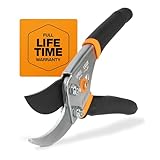
- CLEAN CUTS FOR LIVE GROWTH: Bypass blade design is ideal for pruning delicate flower stems and green growth, helping reduce crushing and plant damage while cutting stems and small branches up to 5/8” in diameter
- BLADES STAY SHARP: Precision-ground steel blades are engineered to stay sharp through heavy use, & all-steel construction provides lasting durability, delivering consistent cutting performance for regular garden maintenance & detailed pruning tasks
- SMART BLADE FEATURES: Blade coating helps reduce friction for smoother cuts, minimizes sap buildup & gumming, and enhances resistance to rust for longer-lasting performance in outdoor conditions; sap groove keeps the blades from sticking during use
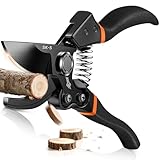
- Unbreakable sharpness! Japanese SK5 steel blade with titanium coating endures 100,000 cuts. Built for lifelong clean cuts
- 2026 UPGRADE SHARPNESS & DURABILITY: DECERK pruning shears are crafted from SK5 steel and coated with a 3-layer titanium alloy for superior durability and corrosion resistance. Anodized aluminum handles and high-hardness fixing screws ensure superior strength, making decerk secateurs five times more durable than ordinary models while maintaining outstanding sharpness after 100,000 tests
- POWERFUL LEVER CUTTING TECHNOLOGY: Garden shears feature an innovative lever cutting design that triples the cutting force, making it effortless to prune thicker branches. Perfect for branches up to 1 inch in diameter, the lever mechanism enhances cutting power through an optimized structure, allowing you to handle thick, wet, or dry wood with ease
2. Loopers
If you have seen both a pruning shear and looper, you’d know that the latter is practically nothing but a bigger variant of shears. While the pruning head looks similar, the handles are large enough to be held with both hands.
In fact, the length of the handles is what provides these tools with high leverage without putting too much strain on your hands. You can easily cut any branch that fits between the open blades, typically up to 1-inch in diameter or slightly more. Interestingly, loopers are also available in bypass and anvil-action designs, meaning that they function pretty much the same way as their pruning shear counterparts.
Since anvil-action loppers are better for trimming thick, dead wood, you don’t really have a lot to think about, apart from positioning the blade at the right spot.
But for bypass loopers, you’d want to start by aligning the blade at the spot from where you’d perform the cut. Owing to its curved blade design, it will go around the side of the branch. As a result, the hold of the blade may shift by around ¼ inches when you flip the handles to make the cut.
Once the blade is aligned, extend the handles completely to ensure that the branch sits deep into the blade. This is a crucial step in the process as a lesser firm hold will require more force to tire your hands and dull the blade. Finally, close the handles in one swift motion to complete the cut.
If the branch is too thick for the blade, the looper may fail to snap in at one go. In that case, you may need to repeat the process one more time.

- Lightweight strong, long aluminium handles for easy reach and overhead cutting
- Less fatigue with properly balanced design
- Powerful smooth cut with the narrow blade combined with the thin counter blade

- Sharp SK5 Steel Blade, Effortless Cut to 1.8” Limit: The sharp shark-shaped SK5 steel blade makes cutting green, fresh branches smooth and effortless without bending or cracking. Designed for thick limbs, hardwood, and overgrown branches up to 1.8 inches. Ideal for trees, shrubs, fruit trees, and heavy pruning jobs
- 3-Section Telescoping Handles, Multi Length with Smooth and Secure Adjustment: You can adjust the length rods from 24 to 42 inch for cutting substantial branches without the hassle of ladders or excessive physical strain. Telescoping rods slide smoothly and lock firmly in place—no wobble, no slipping during cutting
- Compound Action Mechanism, 4 Pivot Points for Maximum Leverage: Compound action mechanism multiplies cutting force for clean, controlled cuts. The advanced 4-pivot-point design multiplies cutting force, allowing you to cut thicker, harder materials with less effort and reduced hand strain
3. Pole Pruner
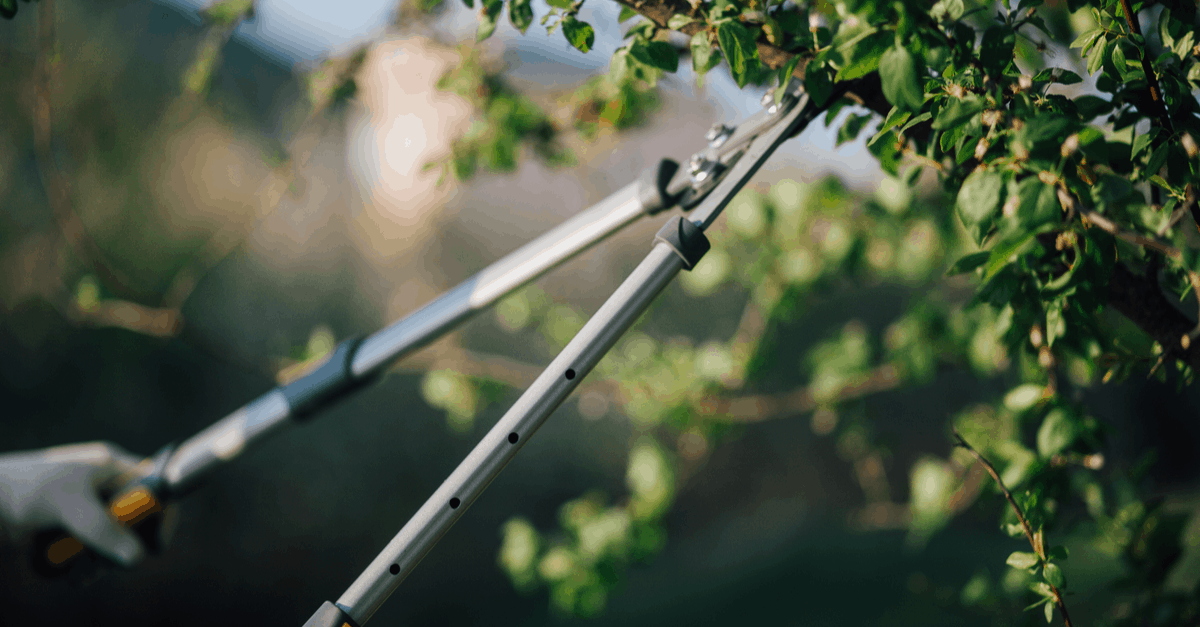
Undoubtedly, pole pruners are the most popular category for professionals and DIY enthusiasts alike. As the name suggests, these pruners are attached to a pole, which can be either telescoping or standalone. In case of the former, you will have to extend the pole to reach the desired height (depending on the maximum extension of the model you have opted for).
Likewise, standalone pole pruners can serve the same purpose once you attach the different pole segments to extend the overall height. Here, I should mention that the base pole is usually between 5 and 8 inches long. So, you will need to set up the pruner accordingly before use.
To cut the branches, stand a few feet away from the direction at which the branch will fall after trimming. Remember that standing directly under the tree will increase your chances of getting injured by the falling branch. If the branch is too big, I’d suggest tying it to the tree beforehand.
The next step is to grab the branch with the rope-operated pruner (which is what most pole pruners offer) and ensure that there’s enough space to prevent the pulley system from tangling. Then, pull the rope in one swift motion to get the job done.
One thing to note is that if you’re using the pole in the lower height settings, you may be left with excess rope at the bottom. So, I’d advise wrapping it around the handle or your hands.
On the other hand, if the branch is too thick for the pruner, a serrated saw will come in handy to cut it off with steady back and forth motions. The good news is that most pole pruners already come with this attachment, so that’s a job half done!

- 2-in-1 Saw & Pruner for High Branches: This manual pole saw combines a sharp steel saw blade for thick limbs and a manganese steel pruning scissor for smaller branches. Easily cut twigs up to 1.2 inches while trimming higher tree limbs from the ground — no ladder needed.
- Adjustable Pole Length Up to 14 FT: The pole includes multiple detachable sections, allowing you to customize the working height from 33.6 to 167.9 inches. Ideal for trimming trees, shrubs, vines, palm trees, or overgrown branches in your yard, garden, orchard, or farm.
- High-Strength Blade & Durable Construction: The pruning saw blade is forged from high-carbon steel for efficient cutting, abrasion resistance, and long-term performance. The 65Mn pruning blade holds a sharp edge, while the stainless steel handle provides sturdy control and rust resistance.

- Package Includes: Our pole saw and pruner set contains 7 long poles, 1 head with saw, 1 pruner head, 1 spare saw with sheath, and a carry bag. Its extandabe range is about 7.3 to 27 ft (2.24 m to 8.24 m).
- Lightweight Material: All rods are made of high quality, thickened,epoxy resin and connected by aluminum alloy joints. The blades of the saw are made of alloy steel with 65 Mn, which performs much better than the carbon steel. Just in case you need to reach about 27 ft, its total weight of 7 poles and a head is 9.5 lb.
- Intelligent Design: The tree pruner is included to cut all the crossing branches. The pulley system helps to change the pulling direction and makes the job much easier. The saw features a hook knife on its points and ends to remove twigs. Extra saw is provided just in case the blade got stuck on the branches while trimming. After work, all parts could be collected in one carry bag and ready for storage.
Conclusion
With that, it’s time for me to wrap up today’s guide.
I hope that I could resolve all your queries regarding the types and usage of different tree pruners. But before I finally take your leave, here’s one precautionary advice: always wear adequate safety accessories like goggles, gloves, and head protection, and cover your limbs with a rigid material like denim.
I’ll see you soon with more such content. Till then, take care!