
The adage “the more, the merrier” is true for many things in life, but definitely not for grass seeds!
When I first ventured into the world of gardening, nothing confused me as much as seeding a lawn. After all, no matter what I did, the grass growth was always either stunted or erratic. Like most other novices, the question on my mind was, how much grass seed do I need?
This was when my father came to my rescue. As a kid, he would let me use the broadcast spreader to disperse the seeds in the yard, and he had the perfect solution to my gardening woes.
Following his advice, I measured my lawn and calculated the amount of grass seed I would need. And as it turns out, I had been planting a greater quantity than what was necessary. This is a common mistake made by beginners, and you can only learn through trial-and-error.
Hi there! I'm Stacy. And today, I'll tell you all about how to determine optimal the grass seed amount for your lawn.
So, without further ado, let's get started!
How Much Grass Seed Is Needed?
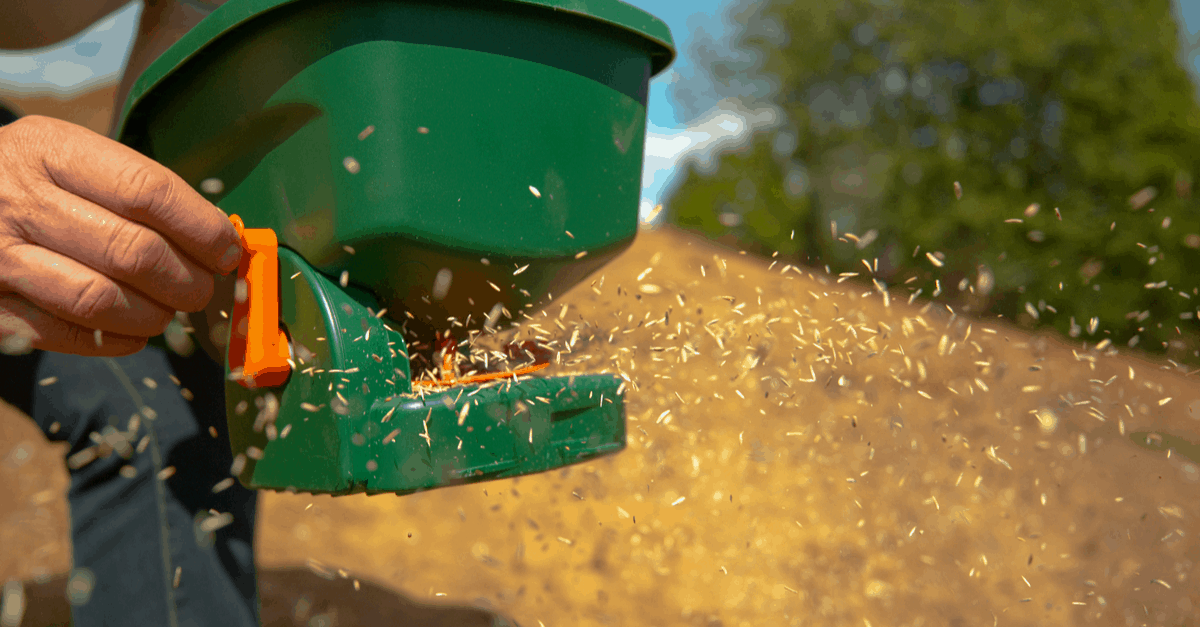
My fellow gardeners and I have frequently grumbled about how tricky getting a ballpark estimate for grass seed can get.
It doesn’t matter whether you're a beginner in the world of gardening or a lawn care expert; finding out the right amount will always be quite a challenge. Therefore, it is essential to be patient and carefully follow a step-by-step process to get an estimate.
An online grass seed calculator will give you the exact quantity in a jiffy, but there are certain other factors you need to consider besides the area. Some of these include the density of growth, the type of lawn, and seed size.
For instance, tall fescue and ryegrass are large seed varieties. They have higher seeding rates since there is a smaller number of seeds per pound. Whatever be the case, it is essential to have an accurate measurement to avoid wastage and ensure proper lawn coverage.
Calculating The Amount Of Grass Seed
Here's a guide that'll help you measure the amount of grass seed needed. But before delving into details, I'd like you to have a rough idea about the quantity you'll need.
For a new lawn, you'll need 35 grams of grass seed per square meter. If the goal is merely overseeding an existing property, you'll need no more than 25 grams per square meter.
However, I think it's important to mention that the sowing rate depends on the grass type. While perennial ryegrass will need 10 pounds per 1,000 sq ft to sow new land, zoysia grass doesn't need more than 2 pounds per 1,000 sq ft for the same.
Also, here's an essential piece of advice. Be generous while calculating and make provisions for errors. I'd recommend keeping a 30% margin that'll allow for discrepancies, replacement of seeds eaten by birds, and future refilling or repair needs.
Now, let's see how you should go about the calculations.
1. Rectangular Lawn
Calculating the amount of seed needed for rectangular or square lawns is pretty simple. With the help of a measuring tape, measure the length and the breadth of the yard and multiply that amount with the grass seed required per square meter.
For instance, if the lawn area is 50 square meters (538 sq ft), you'll need 1,750 grams (or nearly 4 pounds) of grass seed to sow a new lawn.
Usually, most grass seed bags will give you precise instructions about the seeds needed per square foot. So, remember to read the label carefully.
2. Circular Lawn
To get the exact calculation for a circular lawn, you’ll need its area. For this, measure its widest part, also known as the diameter, and divide it in half to get the radius.
Then, square the radius and multiply it by 3.14. This will give you the circular lawn area, and you can multiply it by the amount of grass seeds needed per square meter to get the required quantity.
3. Triangular Lawn
Triangular lawns can get slightly tricky. So, carefully measure the longest side of the yard, and then divide it by half. Then multiply this number by its height.
Once you get the triangle area, multiply it by the recommended grass seed application rate to get an estimate.
4. Irregular Lawn
If you're dealing with a roughly shaped lawn, then you can divide the yard into small triangles and squares and calculate the area of each of these pieces separately. Then, simply add the figures to get the recommended quantity.
No products found.
Tips On Planting Grass Seed
Merely determining the amount of grass seed needed for your lawn isn't enough. There are specific measures you must take to get a lush yard.
The most important consideration is the grass type. There are different warm-season and cool-season grasses with varying growing requirements. Hence, it is essential to do your research and choose a grass type that'll suit your area, lawn type, and lifestyle.
Furthermore, you might think that planting more than the recommended amount of seeds will result in a lusher lawn, but that's far from the truth. It'll lead to competition among the seeds for root space and result in barren patches. So, plant the seeds in moderation and adequately fertilize them to ensure dense growth.
Lastly, keep the freshly seeded lawn consistently moist to help in germination and gradual development of the grass.
Conclusion
That’s all for today, folks!
I hope this guide will be helpful whenever you decide to plant new seeds or overseed your lawn.
Remember that getting a ballpark estimate of the grass seed quantity is just the first step to getting a flourishing lawn. The next important step is planting the seeds right and taking care of the yard’s mowing, fertilizing, and watering needs to ensure optimal growth.
If you carefully follow all the steps, you will undoubtedly have a lush lawn within a year. Now, I’ll take my leave, but I’ll be back with more such guides.
Until next time, happy gardening!